9 Best Rotary Fiber Laser Engraver (November 2026)
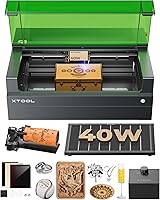
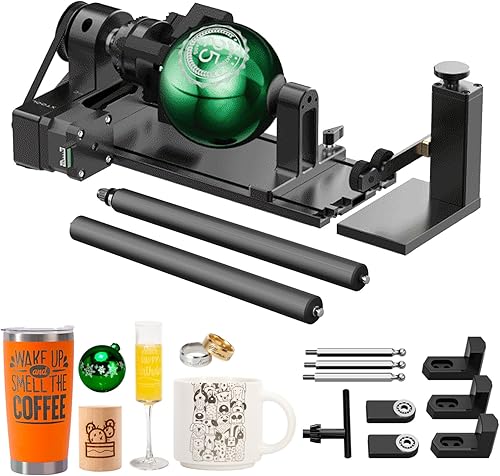
The best rotary fiber laser engravers include the xTool RA2 Pro for xTool S1 for flexible rotary attachments, the ORTUR YRC1.0 for chuck and sphere projects, and the xTool S1 40W Laser Cutter and Laser for a complete rotary machine.
On this page (6 sections)
The best rotary fiber laser engraver setup is the xTool S1 40W Rotary Bundle for buyers who want a complete machine with rotary capability. For a broader machine comparison, see the best laser marking machines.
The xTool RA2 Pro is the better attachment for flexible object handling, while the ORTUR YRC1.0 is a strong choice for chuck, ring and sphere work.
Rotary engraving turns a flat-bed laser into a tool for cylindrical workpieces. You can mark tumblers, bottles, cups, rings, balls and other round objects, but the attachment must match the machine, object diameter and material.
If metal is your main material, start with our guide to the Best Fiber Laser For Metal. For power comparisons, see the best fiber laser engraver 30w and best 50w fiber laser engraver roundups.
Our picks at a glance
-
1
-
2

-
3
 Best for a complete rotary machine
xTool S1 40W Laser Cutter and Laser
9.5/10 our score
See it on Amazon
- 4
 Check it
LaserPecker LP2 Laser Engraver with Roller
Best for portable roller engraving - 5
 Best for a simple roller upgradeCheck it
- 6
 Check it
ACMER S1 Laser Engraver Machine
Best for compact craft work - 7
 Check it
BlazeX M3 10W Laser Engraver Machine
Best for enclosed beginner rotary work - 8
 Check it
CREALITY FALCON 10w Laser Engraver with Air
Best for air-assisted rotary cutting - 9
 Best for wide diameter coverageCheck it
How we chose the best rotary fiber laser engraver options
We compared rotary modes, object size ranges, machine power, work areas, enclosure details, software support and setup style. That approach helps separate a simple roller from a chuck system and from a complete machine.
The score weighs specs, features and buyer feedback against what you are shopping for. It is not a claim about every material or every object shape.
A complete machine can be the simplest route if you do not already own a laser. One box gives you the laser, the bed, the enclosure where fitted and the rotary parts meant to work together.
An attachment can cost less space and keep your current workflow. You keep a machine you already know, and you add rotation for cups, bottles and similar round pieces.
Before ordering an attachment you must confirm connector, software, riser and clearance requirements. A rotary that fits one model may not fit another, even when the brand name looks similar.
Rotary systems also differ in how they hold the workpiece. Rollers support an object from below on rotating wheels.
Chuck systems grip the object with jaws, which can help with tapered, handled or irregular pieces. That grip also means more setup steps for jaw size, centering and tailstock position.
A 4-in-1 system adds more ways to hold irregular objects, rings and spheres. More modes suit mixed project lists, but they also ask you to learn more adjustments.
For daily use, ask who the setup suits most. A hobby maker who engraves one type of tumbler may value speed and simple setup over extra modules.
A seller who takes varied orders may value chuck, ring and sphere options more. The right pick depends on the objects you plan to make most often.
We also looked at care and trade offs, not just headline specs. A larger bed helps flat projects, while a compact frame helps storage, and an enclosed design changes how you plan the workspace.
Software support matters in daily use as well. Check whether your machine works with the software you already use, such as LightBurn or LaserGRBL, before you commit.
Setup style is another practical filter. Preassembled and modular designs can shorten the first setup, while multi step chuck systems may need more practice.
We favoured clear compatibility information over vague claims. If a product needs a riser, a wiring change or a specific software profile, that detail belongs in your decision.
In short, match the rotary mode to your object shapes first. Then check diameter range, machine fit and the space you have for the machine and the workpiece.
| Product | Best for | Design | Compatibility | Maximum speed | Our score |
|---|---|---|---|---|---|
| xTool RA2 Pro for xTool S1 | flexible rotary attachments | 4-in-1 rotary attachment | xTool S1, F1, F1 Ultra, P2, M1 Ultra, D1 Pro and most laser engravers | 360 degrees_per_second | 9.7 |
| ORTUR YRC1.0 | chuck and sphere projects | All ORTUR machines and most laser engravers | 9.6 | ||
| xTool S1 40W Laser Cutter and Laser | a complete rotary machine | 9.5 | |||
| LaserPecker LP2 Laser Engraver with Roller | portable roller engraving | 9.3 | |||
| ORTUR Laser Rotary Roller | a simple roller upgrade | 9.1 | |||
| ACMER S1 Laser Engraver Machine | compact craft work | 9.0 | |||
| BlazeX M3 10W Laser Engraver Machine | enclosed beginner rotary work | 9.0 | |||
| CREALITY FALCON 10w Laser Engraver with Air | air-assisted rotary cutting | 8.8 | |||
| Longer Rotary Roller Series | wide diameter coverage | 8.2 |
Best rotary fiber laser engraver picks
The xTool RA2 Pro leads this list because it covers the widest range of rotary jobs in one modular attachment. The remaining picks make sense when you value a chuck, a complete machine, portability, compact storage or a broad diameter range.
xTool RA2 Pro for xTool S1: Best for flexible rotary attachments
- 4-in-1 rotary design
- Roller, chuck, sphere and ring modules
- 360 degrees_per_second maximum rotational speed
- 0 mm to 100 mm jaw diameter
The RA2 Pro gives one attachment several rotary modes for cylinders, spheres, rings and irregular objects. Its adjustable Z-axis and chuck diameter make it the most flexible choice in this group.
Pros
- 4-in-1 design
- Supports irregular cylinders and rings
- Pre-assembled modular design
Cons
- Must be used with a riser for xTool S1
- More setup choices than a basic roller
The xTool RA2 Pro is the most versatile attachment here. Its 4-in-1 design includes a roller rotary, chuck rotary, sphere-engraving module and ring-engraving stud, so you can switch between common cylinders, balls, rings and irregular items.
The chuck jaws hold objects from 0 mm to 100 mm in diameter, while the support module helps with objects such as wine glasses, wine bottles and tumblers. The attachment also supports extra-long cylinders and objects such as baseball bats and ceramic vases.
Its maximum rotational speed is 360 degrees_per_second, and the minimum stated speed is 36 degrees_per_second. A 0.45-degree minimum angle supports controlled movement for detailed work.
The RA2 Pro is compatible with xTool S1, F1, F1 Ultra, P2, M1 Ultra, D1 Pro and most laser engravers. It works with Laserbox Basic, LaserGRBL and LightBurn.
Note that the xTool S1 requires a riser.
Choose it when one rotary attachment needs to cover the widest variety of objects. Its extra modules add flexibility, but they also give you more setup choices to learn.
ORTUR YRC1.0: Best for chuck and sphere projects
- Chuck, ring and sphere modes
- 1 mm to 120 mm cylindrical diameter range
- 25 mm to 150 mm sphere range
- 360 degrees_per_second engraving rotation
ORTUR's all-in-one Y-axis chuck covers cylinders, rings and spheres with a wide size range. Four installation steps keep the setup more approachable than a multi-part rotary system.
Pros
- Wide object-size range
- Chuck, ring and sphere modes
- Supports LaserGRBL and LightBurn
Cons
- Compatibility with non-ORTUR machines still needs checking
- Heavier than the basic roller
The ORTUR YRC1.0 is the best fit for buyers who want a chuck rotary with ring and sphere modes. Its cylindrical diameter range runs from 1 mm to 120 mm, with a 25 mm to 150 mm sphere range and an 11 mm to 100 mm ring range.
The all-in-one aluminum frame supports 180-degree angle adjustment and 360-degree rotation engraving. That combination suits tumblers, beverage cans, goblets, wine bottles, baseballs, rings and mugs with handles.
Setup uses 4 main steps: expand or shrink the chuck, install or change the jaw, assemble the tailstock and adjust the chuck angle. It is compatible with ORTUR laser engravers and most laser engravers, plus Laser Explorer, LaserGRBL and LightBurn.
The unit weighs 1.69 kg and includes a chuck key or spanner. Windows XP through 10, Mac OS and Linux are supported.
Pick it when you want more gripping control than a basic roller. Confirm your machine's connector and working clearance before starting a project.
xTool S1 40W Laser Cutter and Laser: Best for a complete rotary machine
- 40W laser
- 23.93 in x 15.16 in bed size
- 600 mm/s speed
- Rotary bundle
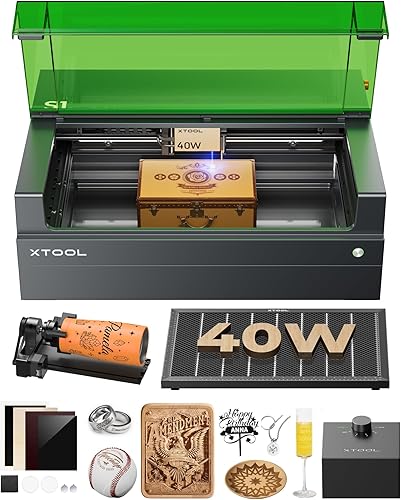
The xTool S1 40W Rotary Bundle combines a high-power machine with a rotary workflow. Its large bed and enclosed Class 1 design suit buyers who need cylindrical and flat projects from one setup.
Pros
- Complete rotary bundle
- 40W power
- Large work area
Cons
- 86.8 lb item weight
- More machine than buyers who only need a rotary attachment
The xTool S1 40W Rotary Bundle is the best complete-machine choice because it combines rotary work with a large flat-bed workspace. Its 40W laser and 23.93 in x 15.16 in bed suit buyers who want one machine for cylindrical and larger flat projects.
The machine reaches a stated speed of up to 600 mm/s. Its rotary bundle is aimed at tumbler work, while the bed gives you room for signs, panels and other larger designs.
The enclosed design is Class 1, and the protective cover filters 99% of laser light. It also has 5 flame sensors, an emergency stop button and a lid-open stop feature.
The xTool S1 weighs 86.8 lb, so plan a permanent work area before buying. Its corded electric power source also favors a fixed studio or workshop setup rather than frequent movement.
Choose it when you need a full laser machine and rotary workflow together. If you already own a compatible laser, an attachment such as the RA2 Pro may be the more focused choice.
LaserPecker LP2 Laser Engraver with Roller: Best for portable roller engraving
- Portable handheld design
- Versatile electric roller
- 1417 in/min maximum engraving speed
- Cylinder, slab and trolley modes
The LP2 is the portable pick for smaller rotary work and flexible positioning. Its roller handles cylinders, while slab and trolley modes extend the engraving length.
Pros
- Portable 10.25 lb design
- Electric roller included
- Smartphone and PC connection
Cons
- Limited metal materials
- Requires an 11 cm laser distance
The LaserPecker LP2 is the portable rotary pick, with a 10.25 lb handheld machine and a versatile electric roller. Its cylinder mode handles round objects such as tumblers and pencils, while slab and trolley modes extend engraving length up to 196 in with a 4 in width.
The LP2 reaches a stated maximum engraving speed of 1417 in/min. Its 0.05 mm compressed spot and 1K, 1.3K and 2K resolution options give you control over detail level.
Material limits matter here. It can engrave paper, cardboard, wood, leather, coated metal and brushed stainless steel, but it cannot engrave pure metal or shiny metal.
For pure metal work, compare 60W fiber laser engravers.
The package includes the laser unit, electric roller, electric stand, conical protective cover, adapter, safety glasses, 2 Type-C cables and an English manual. It connects to a smartphone or PC and uses an 11 cm laser distance.
Choose it for portable cylinder work and smaller creative spaces. Pick a different machine if pure metal engraving is your main goal.
ORTUR Laser Rotary Roller: Best for a simple roller upgrade
- 360-degree rotation
- 7 adjustment diameters
- 8 mm to 110 mm diameter range
- 2.4 lb item weight
This roller keeps cylindrical engraving simple with 7 diameter adjustments. It fits buyers who want a lightweight module for cups, bottles, tubes and similar round workpieces.
Pros
- Lightweight
- 7 diameter adjustments
- Works with many machine brands
Cons
- Roller design has fewer modes than a chuck rotary
- Cable wiring may need swapping for other brands
The ORTUR Laser Rotary Roller is a simple upgrade for buyers who need a lightweight roller rather than a multi-mode chuck. It weighs 2.4 lb and offers 7 adjustment diameters from 8 mm to 110 mm.
The roller supports 360-degree rotation for round wood, cups, bottles, pipes, bowls, guitars, drums and tubes. It can also support over-length plate engraving or cutting, depending on the laser machine and setup.
LaserGRBL and LightBurn are supported, along with Windows XP, 7, 8 and 10, Mac OS and Linux. The roller is designed to work with many machine brands, including ORTUR, ATOMSTACK, SCULPFUN, Aufero and Tws.
A wiring change may be needed with some other brands. The instructions specify swapping the blue and green wires at one end of the cable for certain machines.
Choose it when you want a low-weight roller for standard cylindrical objects. It has fewer holding modes than the chuck-based choices, so it is less suited to rings, spheres or irregular shapes.
ACMER S1 Laser Engraver Machine: Best for compact craft work
- 2500mW laser power
- 24W machine output
- 130 mm x 130 mm work area
- 2 kg compact design
The ACMER S1 is a compact machine for small craft projects and buyers with limited storage. Its 130 mm x 130 mm work area is easier to place at home than a large bed.
Pros
- Compact 2 kg design
- Preassembled setup
- Supports several file formats
Cons
- Smallest work area among the complete machines
- Rotary attachment details need confirmation before purchase
The ACMER S1 is the compact craft machine in this group. Its 130 mm x 130 mm work area, 2 kg weight and 250 mm x 250 mm x 162 mm machine size make it easier to store in a home workspace.
The machine has 2500mW laser power, 24W machine output, a 455±5nm wavelength and a 2 mm focal length. Its stated engraving speed reaches 10,000 mm/min, with 0.01 mm repeatable positioning accuracy.
It can engrave wood, bamboo, leather, plastic, PCB, aluminum oxide and ceramics, and it can cut thin plywood, MDF and acrylic. The machine supports ACMER Studio, LightBurn and LaserGRBL, plus NC, DXF, BMP, JPG and PNG files.
The ACMER S1 arrives 99% preassembled, with a 1-minute laser head installation. Its compact size helps small projects, but the rotary attachment information is less complete than the dedicated rotary systems above.
Choose it when storage space and small craft work matter most. Confirm rotary compatibility and the usable object size before planning tumbler projects.
BlazeX M3 10W Laser Engraver Machine: Best for enclosed beginner rotary work
- 10W laser
- Rotary roller with height risers
- 0.01 mm accuracy
- Class 1 enclosure
The BlazeX M3 packages a rotary roller, risers, enclosure and starter materials for a guided desktop setup. Height risers help make room for thicker cylindrical objects.
Pros
- Height risers included
- Class 1 enclosure
- Supports LightBurn, LaserGRBL and CutLabX
Cons
- 10W power is below the xTool S1 bundle
- Larger 16.22 lb desktop footprint
The BlazeX M3 suits beginners who want an enclosed rotary setup with extra clearance for thick objects. Its 10W laser, rotary roller and multi-stage height risers are designed for 360-degree cylindrical engraving.
The kit includes a protective enclosure, toolkit, 13 materials and a honeycomb engraving bed. The honeycomb bed supports airflow and helps protect the work surface during projects.
The machine states 0.01 mm accuracy and is designed for wood, leather, glass and coated metal among more than 300 materials. It supports LightBurn, LaserGRBL and CutLabX across Windows, macOS, iOS and Android.
Its Class 1 design filters harmful radiation, while the fan exhausts smoke and odors. Tilt and lid sensors stop the machine when those conditions are detected.
The machine weighs 16.22 lb and measures 14.28 x 11.6 x 8.28 in. Choose it for a guided desktop setup with included rotary clearance, especially if you prefer an enclosed machine.
CREALITY FALCON 10w Laser Engraver with Air: Best for air-assisted rotary cutting
- 10,000mW output power
- Air assist
- 4-in-1 rotary roller
- 1 mm to 110 mm outside diameter range
The CREALITY FALCON combines a 10W machine with air assist and a 4-in-1 rotary kit. It suits makers who want cleaner cutting edges and several ways to hold cylindrical, spherical and ring-shaped pieces.
Pros
- Air assist included
- 4-in-1 rotary kit
- Up to 10,000 mm/min speed
Cons
- Class 4 laser requires careful safety practice
- 20.1 lb machine weight
The CREALITY FALCON 10w is the best choice here for air-assisted rotary cutting. It combines a 10,000mW output laser, adjustable air pump and 4-in-1 rotary kit for cylinders, spheres and rings.
The rotary kit supports outside clamping from 1 mm to 110 mm, inside support from 25 mm to 75 mm, sphere work from 10 mm to 130 mm and ring-shaped items from 15 mm to 100 mm.
Air assist removes smoke and dust during cutting or engraving. It can help limit excessive burning and support cleaner cutting edges, but safe ventilation and material checks remain necessary.
The machine reaches a stated speed of up to 10,000 mm/min and uses a 0.06 mm laser spot. It supports LaserGRBL and LightBurn on Windows and macOS, with offline creation through a TF card.
This is a Class 4 laser machine, so treat enclosure, eye protection, ventilation and operating instructions as core setup requirements. Choose it when air assist and multiple rotary holding methods matter more than compact size.
Longer Rotary Roller Series: Best for wide diameter coverage
- 360-degree rotation
- 6 mm to 200 mm adjustable diameter
- Two wiring options
- Steel construction
The Longer Rotary Roller Series is the practical pick when workpiece diameter matters most. Its sliding adjustment and two wiring options help it fit a broad range of compatible engravers.
Pros
- Wide stated diameter range
- Two wiring options
- Anti-slip rubber shaft
Cons
- Compatibility depends on the correct wiring
- Basic roller design
The Longer Rotary Roller Series is the practical pick for a wide diameter range. Its adjustment range is stated as 6 mm to 200 mm, covering small objects and larger cylinders such as cups, bottles, pipes and drums.
The roller rotates 360 degrees and uses a sliding adjustment system. Its steel construction and 70A anti-slip rubber shaft help keep the workpiece positioned during rotation.
Two wiring options broaden compatibility. The white connector is intended for Longer RAY5, Laser B1 series and 80% of engravers, while the black connector is intended for other machines when the first option does not work.
The unit weighs 3.23 lb and measures 13.7 x 10.03 x 3.36 in. Scales and grooves on both sides support parallel positioning.
Choose it when diameter coverage is your main concern. It is a basic roller, so buyers who need firm gripping for spheres, rings or irregular objects should consider a chuck or 4-in-1 rotary system.
How do you choose a rotary fiber laser engraver?
Choose the rotary system by machine compatibility first, then by holding method, diameter range and material. A strong attachment cannot fix a connector, clearance or software mismatch.
For a roller, check the smallest and largest supported diameter and whether the wheels can hold your object without slipping. Rollers are convenient for common round workpieces, but tapered or irregular items may need a chuck or support module.
For a chuck, check jaw range, tailstock adjustment and whether the object can be held from the outside or inside. The xTool RA2 Pro and ORTUR YRC1.0 offer more modes than the basic roller products here.
If you are new to this workflow, read How to Use a Fiber Laser Engraver before mounting a tumbler. The guide can help you plan alignment, focus, rotation direction and test marks.
What size and shape can a rotary attachment hold?
The answer depends on the attachment. The xTool RA2 Pro supports 0 mm to 100 mm jaw diameter, the ORTUR YRC1.0 supports 1 mm to 120 mm cylinders, and the Longer roller states 6 mm to 200 mm.
Those ranges describe holding capacity, not a promise that every object in the range will engrave cleanly. Material, coating, focus and alignment still affect the result.
Shape matters as much as diameter. A straight tumbler is usually simpler than a mug with a handle, wine glass, ball or ring.
A roller works well when the object rests evenly and rotates in a true circle. Tapered sides, handles and stems can shift the center line and make alignment harder.
Chuck systems can grip the ends of an object more firmly. That helps with irregular pieces, but the jaws still need the right size and position.
Sphere and ring modules add holding options for objects a roller cannot seat well. They suit balls and rings, yet they ask for more careful centering before a run.
Height risers help create clearance for thicker objects. Extra height only helps if the laser can still reach the correct focus distance.
Measure the widest and narrowest points of the workpiece before choosing. Diameter at the jaws and at the middle of the design area can differ on real cups and bottles.
Also check the machine bed, riser height, laser focus distance and the space needed for the object to rotate without touching the frame. A long object needs room at both ends, not just in the middle.
For extra long pieces, check whether a support module or tailstock is included. Support at the far end helps reduce wobble during rotation.
Small objects have their own trade offs. A ring or small ball may fit the stated range, but fine centering and test marks become more important.
Keep the object length in mind as well as the diameter. Rotary systems list diameter most clearly, while length depends on the machine frame and support setup.
If you switch between large and small pieces, a wider stated range can reduce how often you change hardware. It does not remove the need to test each new object type.
Care also matters for repeated use. Clean rollers, jaws and support points so residue does not change grip or alignment.
Choose based on your most common workpiece first. A broad range is useful, but a secure hold for the shapes you make weekly matters more.
When in doubt, measure first and compare the numbers to the attachment specs. That simple step prevents many clearance and focus problems later.
How should you set up a rotary laser engraver?
Start with the machine powered off, mount the rotary attachment according to its instructions and confirm that the workpiece is centered. Check that cables and the attachment sit where they will not be pulled during rotation.
Rotate the object by hand before engraving to check for contact, wobble or clearance problems. If the object touches the frame, the bed or a riser, stop and adjust before you run the laser.
Use the correct software profile and confirm the rotary axis direction. A wrong profile can change speed, rotation and scale, so a short test run is not wasted time.
Begin with a small test mark on the same material and coating as the final workpiece, then adjust focus, speed and power according to the machine instructions. Test on a spare piece first, because settings that suit wood may not suit coated metal or glass.
Keep smoke control and fire safety in the work area. Ventilation, a clean surface and close attention during the run are part of normal setup, not optional extras.
Class 4 systems such as the CREALITY FALCON need especially careful handling, and an enclosure does not replace safe operating practice. Read the manual for eye protection, ventilation and supervision requirements for your exact machine.
For glass work, follow our guide on How to Use a Laser Rotary Attachment for Glass. Glass often needs a different marking approach from coated metal, wood or acrylic.
Set the focus distance after the object is mounted, not before. A curved surface moves in and out of focus as it turns, so the test mark shows whether the setting suits the design area.
Check the design orientation on the curved surface before a full run. Text and images can wrap, stretch or mirror depending on the software profile and rotation direction.
Secure the workpiece so it cannot slip or roll off the rollers. A loose object can shift mid run and turn a full design into a failed piece.
After the run, let the piece and machine cool as directed before handling the workpiece. Clean the rotary parts and check for residue that could affect the next setup.
For beginners, learn one object type at a time. Master centering and test marks for a plain tumbler before moving to handled, tapered or spherical pieces.
Keep notes on settings for each material and object shape. Those notes make repeat jobs faster and reduce guesswork when you change workpieces.
If the result looks uneven, check alignment first. Wobble, off center mounting and poor focus are common causes before power or speed need changing.
Which rotary fiber laser engraver should you choose?
Pick the xTool S1 40W Rotary Bundle if you want a complete machine with a large work area and rotary workflow. It suits buyers who need flat projects and cylindrical work from one setup.
Pick the xTool RA2 Pro if you already have a compatible laser and need the broadest mix of roller, chuck, sphere and ring modes. It is an attachment choice, not a full machine.
Choose the ORTUR YRC1.0 for chuck based projects across cylinders, spheres and rings. Its wider stated cylinder range and four step setup suit makers who want firm gripping.
The LaserPecker LP2 fits portable work where a smaller handheld machine matters more than a large bed. Check its material limits first if metal is your main workpiece.
The ORTUR Laser Rotary Roller suits a basic, lightweight roller upgrade. It covers standard round objects with fewer modes and a simpler setup.
For enclosed beginner work, the BlazeX M3 adds risers, a roller and starter materials. Height risers help when thick cylinders need more vertical clearance.
For air assisted cutting, choose the CREALITY FALCON. Air assist can help with cleaner edges, but it is a Class 4 machine and needs careful safety practice.
For a broad diameter range, consider the Longer Rotary Roller Series. Its stated range is wide, while the basic roller design suits common cylinders more than spheres or rings.
The ACMER S1 suits compact craft work and limited storage. Its small work area is a trade off, so confirm rotary fit before planning tumbler projects.
If you already own a compatible machine, start with an attachment. That route keeps your current workflow and avoids paying for a second laser you may not need.
If you do not own a machine, compare complete setups by bed size, enclosure, software and rotary clearance. The best pick is the one that fits your space and your most common objects.
Match the final choice to your materials as well as your shapes. A rotary system cannot fix a laser that suits the wrong material for your work.
Our top 3 picks at a glance
-
1
-
2
-
3
Best for a complete rotary machine
xTool S1 40W Laser Cutter and Laser
9.5/10 our score
See it on Amazon
Frequently asked questions
What is the best rotary fiber laser engraver for most buyers?
The xTool S1 40W Rotary Bundle is the strongest complete-machine choice because it combines 40W power, a 23.93 in x 15.16 in bed and a rotary bundle. If you already own a compatible machine, the xTool RA2 Pro adds roller, chuck, sphere and ring modes without replacing the laser.
What is the difference between a rotary roller and a chuck rotary?
A roller supports an object on rotating wheels, while a chuck holds it with jaws. Rollers suit common cylinders such as cups and bottles.
Chuck systems usually give you more control over irregular shapes, rings, spheres and objects that need firm gripping.
Can a rotary attachment engrave tumblers?
Yes, several products here are designed for cylindrical objects such as tumblers, cups, bottles and cans. Check the attachment's diameter range, clearance and machine compatibility first.
A mug handle or tapered tumbler may need a chuck, support module or height risers.
Is a fiber laser required for rotary engraving?
No. Rotary attachments can work with different laser engraver types, but the laser source controls which materials you can mark.
The LaserPecker LP2, for example, handles coated metal and brushed stainless steel but not pure or shiny metal.
Match the machine to your material.