9 Best Laser Engravers for Plastic and Metal (November 2026)
The best laser engravers for plastic and metal include the xTool S1 40W Laser Cutter and Laser for large plastic and metal projects, the BlazeX M3 10W Laser Engraver Machine for detailed metal and plastic work, and the xTool F2 5W IR & 15W Diode for bare metal color marking.
On this page (11 sections)
- What makes a laser engraver good for plastic and metal?
- The best laser engravers for plastic and metal, ranked
- How to compare these laser engravers for plastic and metal
- Laser type decides your metal finish
- What power do you need for plastic and how does it affect metal?
- Power for plastic cutting and engraving
- Can a 10W laser engrave metal and plastic at the same time?
- Bed size, camera and rotary support for mixed jobs
- What safety steps matter for plastic and metal work?
- Safety, ventilation and material checks
- Our verdict for the best laser engraver for plastic and metal
The best laser engraver for plastic and metal is the xTool S1 40W, because its 40W power and 23.93 x 15.16 in bed cover large plastic and coated metal jobs in one machine. If bare metal marking is your priority, the xTool F2 dual laser adds a 5W IR head for color marking on metal.
We compared these machines for buyers who need one tool for two material families. Plastic means acrylic, ABS and coated surfaces that melt or mark with a diode laser.
For polymer magazine projects, see laser engravers for PMAGs.
Metal means coated, anodized, painted or brushed finishes, plus bare metal when an IR laser is included.
Our score weighs specs, features and buyer feedback. We checked power, bed size, safety class, camera and rotary support, plus weight, assembly and software fit.
Laser type and material limits came first, since a machine that cannot mark your metal finish will disappoint. For blade projects, compare laser engravers for knives.
Our picks at a glance
-
1
 Best for large plastic and metal projects
xTool S1 40W Laser Cutter and Laser
9.5/10 our score
See it on Amazon -
2
 Best for detailed metal and plastic work
BlazeX M3 10W Laser Engraver Machine
9.4/10 our score
See it on Amazon -
3

- 4
 Check it
LaserPecker LP2 Laser Engraver with Roller
Best for portable coated metal jobs - 5
 Check it
Creality Laser Engraver Machine 10W Output Power
Best for budget 10W cutting and engraving - 6
 Check it
ACMER S1 Laser Engraver Machine
Best for small plastic and coated metal crafts - 7
 Check it
Carverall K15 Pro Laser Engraver 10W Laser
Best for upgradeable metal marking - 8
 Check it
CREALITY FALCON 10w Laser Engraver with Air
Best for tumblers and cylindrical objects - 9
 Check it
Creality Falcon A1 10W Laser Engraver
Best for enclosed large-area work
What makes a laser engraver good for plastic and metal?
A good machine for plastic and metal balances diode power for plastic with the right laser type for your metal finish. Coated metal works with most diode models, while bare stainless steel needs IR or fiber power.
For cutting metal itself, compare laser cutters for metal.
For blade work, compare laser engravers for knives.
Plastic adds its own filter. Dark acrylic cuts cleanly on a diode, clear plastic needs darkening, and PVC should stay off the bed entirely.
To check how engraving works in general, see How Does a Laser Engraver Work?. For a wood focused comparison, our best laser engravers for wood and metal guide covers overlapping picks.
Power is only part of the result
Speed and spot size matter as much as wattage on thin plastic and coated metal. A fine spot gives cleaner text on a tag, while higher speed helps on batch runs of coasters or phone cases.
Focus control also matters, because a slightly out of focus beam will soften edges on acrylic and make coated metal marks look fuzzy.
Bed size and placement decide waste
A camera preview or pin point positioning saves material on small metal blanks and plastic sheets. That matters when you run many small items in a grid, because one misplaced row can waste a whole sheet.
Large beds help, but placement tools help you use the bed you have without trial cuts.
The best laser engravers for plastic and metal, ranked
The xTool S1 leads on size and power, the xTool F2 leads on bare metal, and the 10W diode models fill the middle for coated metal and plastic crafts. Each pick below states who it suits and where it falls short.
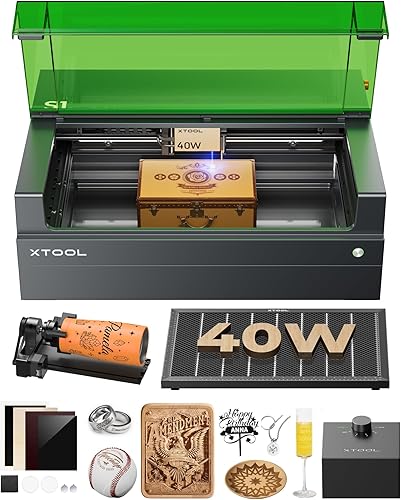
xTool S1 40W Laser Cutter and Laser: Best for large plastic and metal projects
- 40W (40,000mW) laser
- 23.93 x 15.16 in bed
- Up to 600mm/s
- Rotary bundle
- Auto-focus
Big bed and 40W power for large signs, tumblers and batch tags in plastic and metal.
Pros
- Large 23.93 x 15.16 in bed
- 40W power for thick material
- Rotary bundle for tumblers
Cons
- Large footprint at 86.8 lb
- Bare metal marking depends on coating and finish
The xTool S1 suits buyers who want one large machine for signs, door plaques and batch work. Its 40W (40,000mW) laser cuts 18mm cherry wood in a single pass, so thick acrylic and wood backed plastic panels take less time than on 10W models.
The bed measures 23.93 x 15.16 in, which fits large projects and up to 119 dog tags in one run. Speed reaches 600mm/s, and AutoPassthrough supports projects up to 118 inches long.
The rotary bundle handles tumblers and curved items like spoons and plates, with Pin-point Positioning for curved surfaces. Class 1 safety with a cover that filters 99% of laser light helps at home.
The enclosed design blocks smoke and noise, and five flame sensors halt operation if a flame is detected.
Trade-off: at 86.8 lb, this machine needs a stable table and floor space. Bare metal marking still depends on coating and finish, so read our can a 10w laser engrave metal guide before you expect deep bare metal cuts.
BlazeX M3 10W Laser Engraver Machine: Best for detailed metal and plastic work
- 10W laser
- 0.01mm precision
- Smart camera
- Enclosure
- Honeycomb bed
Fine detail, camera placement and an enclosure for clean lines on metal, glass and acrylic.
Pros
- 0.01mm ultra-precision
- Smart camera for placement
- Enclosure and honeycomb bed included
Cons
- 10W diode limits bare metal depth
- Camera and enclosure add size for small desks
The BlazeX M3 suits detail focused buyers who engrave metal, glass and acrylic on a desktop. Its 0.01mm ultra-precision and high density beam help with complex patterns and small text on coated metal and plastic.
A smart camera syncs with software to preview placement on the material. That preview helps you avoid wasted plastic sheets and misplaced metal tags, and it works with LightBurn and CutLabX.
The bundle includes an enclosure, honeycomb bed, tool kit and 13 engraving materials. Class 1 safety, a fan for smoke and sensors that stop the machine if it tilts or the lid opens help in a home studio.
Trade-off: at 10W, this is a diode machine, so bare metal depth is limited compared with the IR models here. Rotary rollers and air assist are add-ons, which adds cost if you need tumblers often.
xTool F2 5W IR & 15W Diode: Best for bare metal color marking
- 5W IR and 15W diode dual laser
- 50MP camera
- 6000mm/s
- 3D embossing
- 4.6 kg portable
Dual laser system for deep, dark color marking on metal plus embossing and cutting on plastic and thick material.
Pros
- 5W IR for metal color marking
- 50MP camera with 0.1mm alignment
- Portable at 4.6 kg
Cons
- Class 4 laser needs strict safety steps
- Small desktop bed without extensions
The xTool F2 suits sellers and event vendors who mark bare metal on site. Its 5W IR laser delivers deep, dark, vivid color marking on metal, while the 15W diode handles 3D embossing and cutting thick plastic.
Speed reaches 6000mm/s, finishing a card engraving in about 3 seconds. A built-in 50MP camera gives up to 0.1mm alignment accuracy on small pieces.
The dual laser setup covers more than 300 materials.
At 4.6 kg, the machine is portable for fairs and pop-ups. The fully enclosed, leak-proof design and built-in fan help with indoor use.
It arrives fully assembled, and material presets reduce setup time between jobs.
Trade-off: xTool lists this as a Class 4 laser, so you need strict safety steps and proper eye protection. The desktop bed is small without the Slide Extension for coasters and phone cases.
LaserPecker LP2 Laser Engraver with Roller: Best for portable coated metal jobs
- Galvo technology
- 1417 in/min max speed
- 0.05mm compressed spot
- Versatile rotary roller
- Handheld design
Portable galvo engraver for coated and brushed metal plus wood and leather, with a roller for cylinders.
Pros
- Portable and handheld
- Roller for tumblers and pencils
- Fast galvo speed
Cons
- Cannot engrave pure or shiny metal
- Light or clear plastic will reflect the laser
The LaserPecker LP2 suits portable work on coated metal, brushed stainless steel, wood and leather. Its galvo technology reaches a max engraving speed of 1417 in/min with a 0.05mm compressed spot for fine detail.
The versatile electric roller enables cylinder mode for tumblers and pencils. Slab mode and trolley mode extend engraving length up to 196 in, while width stays at 4 in.
Plug and play setup with a handheld handle helps with large items that do not fit a bed. Resolution options of 1K, 1.3K and 2K let you trade speed for detail.
The package includes a roller, electric stand, conical protective cover and safety glasses.
Trade-off: the LP2 cannot engrave pure metal or shiny metal. Light color or transparent plastic will reflect the laser, so paint it black first and wipe it clean after.
If metal is your main job, the maker points buyers to the LP3 or LP4.
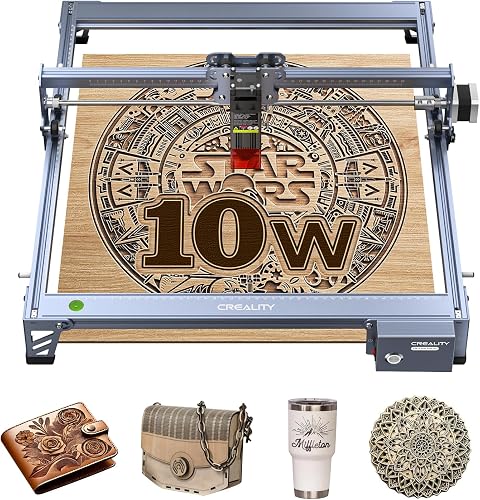
Creality Laser Engraver Machine 10W Output Power: Best for budget 10W cutting and engraving
- 10W output power
- 72W machine power
- 0.06mm spot
- 17 x 16 in size
- Anti-UV filter
10W diode that cuts 5mm basswood and 3mm black acrylic in one pass, with metal engraving on many consumables.
Pros
- Cuts 5mm basswood in one pass
- Fine 0.06mm spot
- Anti-UV filter acrylic module
Cons
- Open frame needs separate eye and fume care
- Shiny metal results vary by finish
This Creality 10W model suits budget buyers who want cutting power for plastic and marking power for coated metal. It has 10W output power with 72W machine power, and cuts 5mm basswood or 3mm black acrylic in one pass.
Speed reaches 10000mm/m, and a 0.06 x 0.06mm spot helps with clean cuts and fine engraving. Accuracy is controlled within 0.004 in, with repositioning accuracy under 0.007 in.
The all aluminum alloy frame and steel shaft guide rails support stable movement.
An anti-UV filter acrylic module filters 97% of UV rays for eye protection. The machine works with LightBurn and LaserGRBL, and data can move by Wi-Fi, USB cable or SD card.
Assembly takes 10 to 20 minutes.
Trade-off: this is an open frame machine, so you must manage fumes, ventilation and eye safety yourself. Shiny metal and reflective plastic still need care, and metal results vary by finish.
ACMER S1 Laser Engraver Machine: Best for small plastic and coated metal crafts
- 2500mW diode laser
- 130x130mm working area
- 10000mm/min speed
- 0.01mm positioning
- 2 kg compact
Compact and light for plastic, PCB, aluminum oxide and ceramics, with coated metal work in a small footprint.
Pros
- Only 2 kg and portable
- Fast 10000mm/min engraving
- 99% preassembled
Cons
- 130x130mm area limits large signs
- 2.5W diode is slower on thick plastic
The ACMER S1 suits beginners and craft sellers who work with small plastic and coated metal items. Its 2500mW diode laser engraves wood, bamboo, leather, plastic, PCB, aluminum oxide and ceramics.
A 130x130mm working area fits tags, keychains, small signs and jewelry blanks. Speed reaches 10000mm/min with 0.01mm repeatable positioning accuracy.
It also supports LightBurn and LaserGRBL across macOS, Windows and Linux.
At 2 kg, the machine is light to carry and store. It arrives 99% preassembled, with 1 minute laser head installation.
Acmerstudio is included free, and files in NC, DXF, BMP, JPG and PNG formats are supported.
Trade-off: the small area and 2.5W diode limit large signs and thick plastic cutting. For wider metal work, compare our Best Laser Engraver For Metal picks and the Best Metal For Laser Engraving guide.
Carverall K15 Pro Laser Engraver 10W Laser: Best for upgradeable metal marking
- 10W laser
- 11.8 x 7.9 in A4 bed
- 0.01mm precision
- 15000mm/min
- Optional 1W IR head
A4 diode machine for coated metal, wood and acrylic, with an optional IR head to add bare metal marking later.
Pros
- Optional 1W IR for stainless steel
- A4 bed covers most daily jobs
- One-touch focus
Cons
- IR head is an optional add-on
- Bare metal needs the upgrade
The Carverall K15 Pro suits buyers who start with coated metal and want a path to bare metal later. Its 10W diode laser works with 300+ materials, including wood, acrylic, leather and coated metal.
The 11.8 x 7.9 in A4 bed covers most daily projects, from signs to coasters and pet tags. Speed reaches 15000mm/min at 0.01mm precision.
One-touch focus and smart memory help with repeat jobs.
You can add an optional 1W IR laser head to engrave stainless steel tumblers and aluminum. The machine also supports offline batch work from a TF card, and CutLabX is free.
Assembly takes about 3 minutes with six screws.
Trade-off: the IR head is not included, so bare metal marking needs that extra purchase. The diode alone is best for coated metal, wood and acrylic, not deep bare metal work.
CREALITY FALCON 10w Laser Engraver with Air: Best for tumblers and cylindrical objects
- 10W output power
- Air assist
- 4-in-1 rotary roller
- 0.06mm spot
- Colors: Black
10W machine with air assist and a rotary kit for plastic, acrylic and metal tumblers and cylindrical objects.
Pros
- Rotary kit for cylinders and spheres
- Air assist for cleaner edges
- Cuts 12mm wood in one pass
Cons
- Class 4 laser needs enclosure care
- Rotary cable can hide deep in foam packing
This Creality Falcon 10W suits buyers who engrave tumblers and cylindrical objects in plastic and metal. It provides 10000mW output power and cuts 12mm wood or 3mm black acrylic in one pass.
The 4-in-1 rotary roller clamps cylinders from 1 to 110mm outside diameter. It also props items from inside at 25 to 75mm, and supports spheres and ring shapes.
The machine works with LaserGRBL and LightBurn on Windows and macOS, plus offline TF card work.
Adjustable air assist removes smoke and dust during cutting and engraving. That helps keep edges cleaner and can prolong laser module life.
The 0.06mm spot supports accuracy within 0.004 in. Assembly takes 10 to 20 minutes.
Trade-off: this is a Class 4 laser, so eye protection and fume control are strict duties. The rotary connection cable can hide deep in the foam packing, so check the box carefully before setup.
Creality Falcon A1 10W Laser Engraver: Best for enclosed large-area work
- 10W diode laser
- 15.0 x 12.0 in area
- 600mm/s
- HD camera
- Fully enclosed Class 1
Fully enclosed, camera-guided machine for large wood, plastic and coated metal projects with Class 1 safety.
Pros
- Fully enclosed Class 1 design
- Large 15.0 x 12.0 in area
- Built-in camera positioning
Cons
- Avoid mirror-finished metal and mirrored acrylic
- Only fits 460 x 346mm honeycomb panels
The Creality Falcon A1 suits buyers who want an enclosed machine for large plastic and coated metal work. Its 10W diode laser cuts up to 6mm wood and 9.6mm black acrylic in a single pass.
The 15.0 x 12.0 in engraving area fits larger projects, and speed reaches 600mm/s. A 0.06 x 0.08mm laser spot helps with sharp, intricate detail.
It is compatible with the Falcon roller kit for tumblers and bottles.
A built-in camera helps position designs, and the fully enclosed Class 1 design with lid-open pause adds safety for beginners. The dual-door design and side openings make loading easier.
The machine comes pre-assembled and works with Falcon Design Space, LightBurn and LaserGRBL.
Trade-off: avoid highly reflective materials, including mirror-finished metals and mirrored acrylic. It is compatible only with 460 x 346mm honeycomb panels, so check accessory size before you buy.
How to compare these laser engravers for plastic and metal
Laser type decides your metal finish
Diode lasers mark coated, painted and anodized metal by removing the top layer. IR and fiber lasers mark bare metal with color change or deeper engraving.
The finish on your stock matters more than the brand name. A coated tumbler, a painted aluminum tag and a bare stainless steel blank will each need a different laser type.
Test a small piece of your actual stock before you commit to a machine for production work.
For pure bare metal work, see our Best Fiber Laser For Metal guide. For diode friendly finishes, the Best Metal For Laser Engraving guide lists common options.
Diode
Most models here use a diode laser. A 10W diode is a strong starting point for plastic, acrylic and coated metal.
The xTool S1 at 40W cuts thicker material faster, while the ACMER S1 at 2.5W suits small items.
Diode power also shapes how thick a plastic you can cut in one pass. The 10W models here cut 3mm black acrylic in one pass, while the 40W xTool S1 has more headroom for thicker stock.
Clear and light colored plastic still needs care, because it can reflect or transmit more light than dark material.
IR and dual laser
The xTool F2 pairs a 5W IR laser with a 15W diode. The IR head handles bare metal color marking, and the diode handles plastic and embossing.
The Carverall K15 Pro offers an optional 1W IR head for the same reason.
A dual laser costs more and adds safety duties, but it removes the need for a second machine. If you sell both metal gifts and acrylic signs, that flexibility can save bench space and setup time.
If you only sell coated metal, a diode alone may be enough.
Coated and brushed metal
The LaserPecker LP2 engraves coating metal and brushed stainless steel, but not pure or shiny metal. That limit is common for diode and galvo diode tools, so confirm your stock finish first.
Software and camera fit
Camera preview, pin point positioning and material presets all reduce waste on mixed jobs. The BlazeX M3, xTool F2 and Creality Falcon A1 each use a camera to check placement before a job starts.
Software support also matters, because LightBurn, LaserGRBL and brand tools each handle files and settings in different ways.
What power do you need for plastic and how does it affect metal?
Power for plastic cutting and engraving
Plastic cutting needs enough power to melt clean edges without flare-ups. The Creality 10W models cut 3mm black acrylic in one pass, while the xTool S1 at 40W cuts thicker stock with more headroom.
Power also affects how long you wait on a sheet. A 40W machine can move through thick acrylic and wood backed panels faster than a 10W machine.
For batch work, that time gap builds up across many sheets. For one off gifts, the gap matters less than placement and finish quality.
40W
The xTool S1 is the only 40W model here. It suits large signs, thick acrylic and batch work where speed matters.
The trade-off is size and weight at 86.8 lb.
10W
Six models here sit at or near 10W. That class cuts 3mm black acrylic and engraves coated metal well.
It is the sweet spot for most home and small business buyers.
Under 10W
The ACMER S1 at 2500mW and the LaserPecker LP2 galvo suit small, thin items. They are slower on thick plastic and limited on bare metal, but they are compact and portable.
Plastic color and thickness checks
Dark plastic absorbs more light and cuts more predictably than clear plastic. Thickness also matters, because a machine that engraves thin plastic cleanly may need multiple passes on thicker stock.
Test the exact color and thickness you plan to sell, and note the settings that work.
Can a 10W laser engrave metal and plastic at the same time?
Bed size, camera and rotary support for mixed jobs
A large bed helps with signs and batch layouts, while a camera helps with placement on expensive metal blanks. Rotary support matters for tumblers, bottles and pencils.
Mixed work means you may switch from a flat acrylic sign to a metal tumbler in the same day. Bed size handles the flat work, camera placement handles small blanks, and rotary support handles cylinders.
A machine that covers all three will save you from swapping machines for each product type.
Bed size
The xTool S1 offers 23.93 x 15.16 in, and the Creality Falcon A1 offers 15.0 x 12.0 in. The ACMER S1 offers only 130x130mm, and the LaserPecker LP2 is limited to 4 in width.
Bed size also decides how many small items you can nest in one run. Dog tags, coasters and jewelry blanks can be laid out in a grid on a large bed.
On a small bed, the same order may need several runs, which adds time and alignment risk.
Camera placement
The BlazeX M3 and xTool F2 use cameras for preview and alignment. The Creality Falcon A1 uses an HD camera for positioning.
These tools reduce waste on metal tags and plastic sheets.
Rotary for cylinders
The xTool S1, LaserPecker LP2 and Creality Falcon 10W include rotary support. The Carverall K15 Pro supports a rotary roller as an add-on.
Choose rotary if tumblers are part of your product list.
Extensions and pass through options
The xTool S1 supports projects up to 118 inches with AutoPassthrough, and the xTool F2 supports a Slide Extension for batch items. Those options help with long signs and repeated small parts.
Check accessory cost and bench space before you plan a large format workflow.
What safety steps matter for plastic and metal work?
Safety, ventilation and material checks
Plastic fumes and laser light are the main risks in this category. Class 1 enclosed machines reduce laser light exposure, while open frame and Class 4 machines need strict controls.
Safety planning should happen before your first cut, not after. Eye protection, ventilation and material checks protect you and anyone else in the room.
They also protect your machine, because smoke and dust can build up on lenses and rails over time.
Eye protection
Enclosed Class 1 models like the BlazeX M3 and Creality Falcon A1 filter laser light. Class 4 models like the xTool F2 and Creality Falcon 10W need proper laser safety glasses and a controlled area.
Fumes and ventilation
Laser cutting plastic creates smoke and odors. Use a fan, purifier or outdoor venting, and never cut PVC or vinyl.
Test unknown plastics in small pieces first.
Reflective material
Shiny metal and clear plastic can reflect the laser. The LaserPecker LP2 maker advises painting light or transparent material black before engraving.
The Creality Falcon A1 warns against mirror-finished metal and mirrored acrylic.
Emergency stops and sensors
Flame sensors, lid open stops and tilt sensors add protection on enclosed and Class 1 models. The xTool S1 has five flame sensors and an emergency stop button.
The BlazeX M3 stops if it tilts or the lid opens. Those features help, but they do not replace ventilation and eye protection.
Our verdict for the best laser engraver for plastic and metal
The xTool S1 40W is the best laser engraver for plastic and metal for most buyers who need size and power. Pick the xTool F2 if bare metal color marking matters most.
Pick the BlazeX M3 for fine detail, or the ACMER S1 for a compact budget start.
Check your metal finish before you order. Coated and anodized metal works across this list, while bare stainless steel needs IR or fiber power.
Then match bed size to your largest plastic sign or metal blank.
Next, read can a 10w laser engrave metal if you are close to buying a 10W diode model. That guide explains what 10W can and cannot do on different metals.
Best pick by use case
Choose the xTool S1 for large signs and batch work, the LaserPecker LP2 for portable coated metal jobs, and the Creality Falcon A1 for enclosed large area work. Choose the Carverall K15 Pro if you want an upgrade path to bare metal with an IR head.
That short list covers most mixed plastic and metal shops without forcing you to buy two machines.
Final checks before you buy
Confirm your plastic types, your metal finish and your largest item size. Then confirm safety class, ventilation needs and software support for your computer setup.
Those checks will help you pick a machine that fits your work today and still makes sense as your product list grows.
Our top 3 picks at a glance
-
1
Best for large plastic and metal projects
xTool S1 40W Laser Cutter and Laser
9.5/10 our score
See it on Amazon -
2
Best for detailed metal and plastic work
BlazeX M3 10W Laser Engraver Machine
9.4/10 our score
See it on Amazon -
3
Frequently asked questions
Can a diode laser engraver handle both plastic and metal?
Yes, most diode models here handle plastic, acrylic and coated metal in one machine. A 10W diode can engrave coated metal and cut many plastics, while bare or shiny metal may need an IR or fiber laser.
Check the metal finish before you buy, and plan on coating or marking light materials dark.
What plastic is safe to laser engrave or cut?
Acrylic and many ABS and PET plastics respond well, while PVC and vinyl can release harmful fumes. Never cut PVC, vinyl or unknown plastics without confirming the material is safe for laser use.
Use ventilation, keep abs types you know, and test small pieces first.
Do I need an IR laser for metal?
You need IR or fiber power for deep marking on bare stainless steel and aluminum. A diode laser works best on coated, painted or anodized metal, where it removes the coating to reveal the metal below.
If bare metal is your main job, choose a dual laser or fiber model.
How does a laser engraver work on plastic and metal?
The laser focuses heat on a small spot to melt, vaporize or discolor the surface. Plastic usually cuts or engraves by melting, while coated metal is marked by removing the coating layer.
Power, speed, focus and material color all change the result, so test settings on scrap first.


