9 Best Laser Engravers for Knives Under $2000 (November 2026)
The best laser engravers for knives under 2000 include the xTool F1 Ultra 20W Fiber & Diode for fast bare-metal marking, the xTool S1 40W Laser Cutter and Laser for large flat and curved projects, and the BlazeX M3 10W Laser Engraver Machine for camera-guided small details.
On this page (9 sections)
- The laser engravers in this roundup, by score
- How do these machines compare for knife marking under 2000 dollars?
- Can a diode laser mark a bare knife blade well?
- What size bed do you need for knives?
- Do you need a rotary attachment for knife handles?
- Fiber, infrared or diode: which laser type is best for knives?
- How fast should a knife engraver be for batch work?
- What safety rules matter for knife engraving at home?
- Which of these is the best laser engraver for knives under 2000?
The best laser engraver for knives under 2000 is the xTool F1 Ultra 20W Fiber & Diode, because it marks bare metal with a fiber laser and adds diode work for wood and acrylic. This guide compares 9 machines by laser type, bed size, rotary handling, speed and safety, so you can match the machine to your blade, handle and budget.
Fiber and infrared lasers mark bare metal more directly than diode lasers. Diode machines can still work well on coated blades, anodized metal and handles, especially with marking prep.
Start with your material, then check bed size and rotary needs.
Our score weighs specs, features and buyer feedback against what you are shopping for. We checked the specs for laser type, power, working area, camera, safety features and included parts.
No prices, star ratings or review counts appear here, so compare the tools by the job they do.
Our picks at a glance
-
1

-
2
 Best for large flat and curved projects
xTool S1 40W Laser Cutter and Laser
9.5/10 our score
See it on Amazon -
3
 Best for camera-guided small details
BlazeX M3 10W Laser Engraver Machine
9.4/10 our score
See it on Amazon
- 4
 Best for portable color marking on metalCheck it
- 5
 Check it
Creality Falcon 5W Laser Engraver Machine
Best for a large bed on a budget - 6
 Check it
ORTUR Laser Master 2 S2 LU2-10A Laser
Best for open-frame 10W cutting power - 7
 Check it
ACMER S1 Laser Engraver Machine
Best for a tiny, simple first machine - 8
 Check it
Twotrees TTS-10 Pro Laser Engraver
Best for coated metal and small parts - 9
 Check it
Creality 72000mW Output Power Laser Engraver
Best for one-button offline control
The laser engravers in this roundup, by score
The top picks lead on metal marking power and speed. The lower picks trade bare-metal power for a lower price, a larger bed or simpler setup.
Choose by blade material first, then by size and workflow.
xTool F1 Ultra 20W Fiber & Diode: Best for fast bare-metal marking
- 20W fiber and 20W diode dual lasers
- Speeds up to 10,000mm/s
- 220mm x 220mm working area
- 16MP camera
- 3D embossing and deep engraving
A fiber laser built for metal, with a diode laser for wood, acrylic, leather and other common materials, in one enclosed desktop unit.
Pros
- Fiber laser engraves all metals
- Very fast for batch work
- Large desktop fiber working area
- Enclosed cover and smoke extraction
Cons
- Auto conveyor is available separately
- Class 4 laser, follow safety rules
- Heaviest pick in this group
This machine suits a maker who marks bare blades all day and wants short cycle times. Its 20W fiber laser engraves gold, silver, copper, stainless steel, brass and titanium, while the 20W diode laser handles wood, acrylic, leather, glass, rubber and fabric.
Speeds up to 10,000mm/s change daily work. A logo that might take minutes on a slower diode machine can finish in seconds here, which helps with batches and in-store custom work.
The enclosed cover filters strong light, and smoke extraction clears fumes.
The 220mm x 220mm working area fits most knife blades and handles. It expands to 220mm x 500mm with the auto conveyor, which is sold separately.
The 16MP camera helps place designs, and the 3D embossing mode adds relief work on metal, wood and rock.
Trade-offs are real. This is a Class 4 laser, so rated eye protection and fire care matter.
The auto conveyor is not included. Even so, for pure knife marking under 2000, dollars the fiber laser is the strongest match in this group.
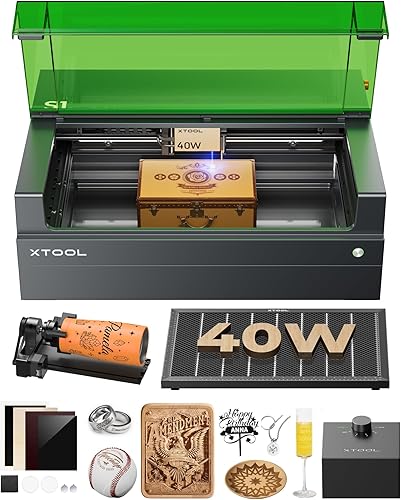
xTool S1 40W Laser Cutter and Laser: Best for large flat and curved projects
- 40W laser
- 23.93 in x 15.16 in bed
- 600mm/s speed
- Rotary bundle
- AutoPassthrough up to 118 in
A 40W bed machine with a rotary bundle for handles and curved pieces, built for large signs and mixed-material projects.
Pros
- Large bed for big projects
- Rotary bundle for curved items
- Cuts 18mm cherry wood in a single pass
- Enclosed Class 1 design
Cons
- Diode-focused, not a fiber metal marker
- Largest and heaviest frame here
- Speed is slower than fiber picks
This machine suits a maker who needs a large bed and rotary work more than fiber-speed metal marking. Its 40W laser cuts 18mm cherry wood in a single pass and engraves at up to 600mm/s on a 23.93 x 15.16 in bed.
The rotary bundle matters for handles. It can mark curved items such as spoons, plates and round handles, where a flat bed alone would work poorly.
AutoPassthrough reaches projects up to 118 in, which helps with long signs and boards.
Camera preview and Pin-point Positioning help place work without waste. The enclosed design filters 99% of laser light, blocks smoke and noise, and includes flame sensors, an emergency stop and a lid-open stop. xTool says the frame is 3mm aerospace-grade aluminum.
The main trade-off is laser type. This is a diode-focused bed machine, not a fiber laser for deep bare-metal work.
It is also the largest unit here at 86.8 pounds. Choose it for size and mixed materials, not for fast bare-blade marking.
BlazeX M3 10W Laser Engraver Machine: Best for camera-guided small details
- 10W laser
- 0.01mm precision
- Smart camera
- Enclosure and honeycomb bed
- 13 engraving materials in kit
A compact 10W machine with camera preview, an enclosure and a honeycomb bed, aimed at beginners who want fine placement on small parts.
Pros
- Smart camera for placement
- All-in-one vision kit
- Class 1 safety design
- Works with LightBurn and CutLabX
Cons
- 10W diode, not for bare steel marking
- Rotary roller is an add-on
- Small-frame class, check bed fit for long blades
This machine suits a beginner who wants camera-guided placement on small blades and parts. Its 10W laser works with 0.01mm precision for fine text and complex patterns on metal and glass, plus clean cuts on wood and acrylic.
The smart camera previews your design on the material before you start. That helps avoid wasting a blade blank with a misplaced logo.
It works with LightBurn and CutLabX, and the kit includes an enclosure, a tool kit, 13 engraving materials and a honeycomb bed.
Class 1 safety design, a fan for smoke and odors, and sensors that stop the machine on tilt or an open lid make it easier to use at home. The weight is 14.97 pounds, so it moves between a bench and storage more easily than the big bed machines.
The trade-off is metal power. A 10W diode is not a fiber laser, so bare steel may need prep or a coating to mark well.
Rotary rollers and risers are add-ons for cylindrical work. For coated knives and small detailed marks, the camera and kit are strong points.
xTool F2 5W IR & 15W Diode: Best for portable color marking on metal
- 5W infrared and 15W diode lasers
- 50MP camera
- Speeds up to 6000mm/s
- Color marking on metal
- 4.6 kg machine weight
A portable dual-laser desktop machine, with infrared for dark color marks on metal and a diode for embossing and cutting thicker materials.
Pros
- Color marking on metal
- Very portable for events
- Fast for small items
- Fully enclosed design
Cons
- Class 4 laser
- Slide extension is an accessory
- Less deep fiber-style engraving power
This machine suits a maker who wants portable color marking on metal at markets and pop-ups. Its 5W infrared laser makes deep, dark, vivid color marks on metal, while the 15W diode laser does 3D embossing and cuts thicker materials.
Speeds up to 6000mm/s are fast for small items. xTool says a card engraving can finish in 3 seconds. The built-in 50MP camera aligns small pieces with up to 0.1mm accuracy, which helps on narrow blades and small tags where placement errors are easy to see.
The enclosed, leak-proof design and built-in fan help with indoor use. At 4.6 kg, it packs up for fairs and events.
It arrives assembled, with material presets that reduce guesswork. Accessories such as the RA3 and Slide Extension add rotary and batch options.
The trade-off is depth. Infrared color marking is not the same as deep fiber engraving.
This is also a Class 4 laser. For dark color logos on metal, it is one of the best fits here.
For deep cut marks in bare steel, look at the fiber pick first.
Creality Falcon 5W Laser Engraver Machine: Best for a large bed on a budget
- 5W laser, 5000mW output
- 400 x 415mm working area
- 10000mm/min speed
- 0.06mm spot
- Offline use
A 5W diode machine with a large 400 x 415mm area for long blades, sheaths and large flat stock, with rotary parts available extra.
Pros
- Large working area
- Fine 0.06mm spot
- Eye-protective cover
- Works on 200+ material types
Cons
- 5W diode, not for bare metal
- Rotary roller and risers are extra
- Class 4 laser
This machine suits a maker who needs bed size for long knives and large flat stock. Its 5W laser has a 400 x 415mm working area, so a full folding knife, a large chef blade or a sheath can fit without diagonal tricks.
Precision comes from a 0.06 x 0.06mm spot, with reposition accuracy under 0.007 in. Speed reaches 10,000mm/min, which helps on wood, leather, acrylic and glass projects.
Offline use lets you run jobs without a computer tether.
The eye-protective cover filters 97% of UV rays, and an active stop halts work if the machine moves. Creality says it works on more than 200 material types.
Rotary rollers and raisers are available extra for cylindrical and tall items.
The trade-off is power. At 5W, this diode machine is not made for bare-metal marking.
It is a Class 4 laser, so eye care and fire watch still apply. Choose it when a long blade needs to fit on the bed, and use coated or prepped metal for marks.
ORTUR Laser Master 2 S2 LU2-10A Laser: Best for open-frame 10W cutting power
- 10000mW laser module
- 390 x 410mm engraving area
- 0.05 x 0.1mm compressed point
- Air-assist interface
- LaserGRBL and LightBurn support
An open-frame 10W diode machine with a large area and air-assist interface, aimed at makers who want cutting depth and software choice.
Pros
- Large engraving area
- Strong 10W module
- G-sensor stops on tilt or move
- Eye-protection cover and glasses included
Cons
- Open frame needs careful eye and fire care
- Class 4 laser
- Diode limits on bare metal
This machine suits a maker who wants 10W diode power on a large open frame. Its 10000mW module has a compressed point of 0.05 x 0.1mm, and the engraving area is 390 x 410mm for long blades and large stock.
It can cut up to 30mm acrylic and 20mm wood, with a built-in air-assist interface for cutting. Assembly takes about 10 to 15 minutes, and the full metal frame helps accuracy.
It works with LaserGRBL and LightBurn on Windows and Mac systems.
Safety features include a G-sensor that stops the laser on tilt or displacement, plus auto-off if the machine sits idle. The protective cover filters 98% of UV light, and glasses are included in the package.
Dual fan cooling helps the module run at steady power.
The trade-off is the open frame. You must manage eye protection, smoke and fire risk with more care than an enclosed Class 1 unit.
This is also a Class 4 laser, and bare metal still needs prep with a diode. For cutting depth and software freedom, it is a strong pick.
ACMER S1 Laser Engraver Machine: Best for a tiny, simple first machine
- 2500mW diode laser
- 130 x 130mm working area
- 10000mm/min speed
- 99% preassembled
- 2 kg compact frame
A very small, light 2.5W diode machine for logos on short blades, handles and small parts, with one-minute laser head setup.
Pros
- Very light and portable
- Simple setup
- Fine positioning accuracy
- Low running size for a bench
Cons
- Small 130 x 130mm area
- Low power for deep marks
- Not suited to bare steel
This machine suits a first-time buyer who wants a tiny, simple setup for small marks. Its 2500mW diode laser covers wood, bamboo, leather, plastic, PCB, aluminum oxide and ceramics, and it cuts thin plywood, MDF and acrylic.
The 130 x 130mm working area is small. It fits pocket knives, small blades, handles and tags, but long kitchen knives will not lie flat.
The frame is 2 kg and 250 x 250 x 162mm, so it stores in a drawer or a small shelf.
Setup is simple, with 99% preassembly and one-minute laser head installation. Acmerstudio software is included free, and LightBurn and LaserGRBL also work.
Speed reaches 10,000mm/min with 0.01mm repeatable positioning, which is enough for fine logos on small parts.
The trade-off is power and size. At 2.5W, it will not match a fiber laser on bare steel, and deep marks will be slow.
It carries Class 4 certification, so eye protection matters. For learning the basics on small pieces, it is a low-risk start.
Twotrees TTS-10 Pro Laser Engraver: Best for coated metal and small parts
- 10000mW optical power
- 300 x 300mm work area
- 450nm blue diode
- TF card offline work
- Air assist pump included
A 10W diode machine for wood, bamboo, acrylic, leather, dark glass and coated or anodized metal, with offline TF card control.
Pros
- Strong 10W diode
- Air assist included
- Offline TF card use
- Dual Y-axis belt drive
Cons
- Bare stainless steel not recommended
- 300 x 300mm area limits long blades
- Needs marking prep on bare metal
This machine suits a maker who marks coated metal and small parts with a 10W diode. Its 10000mW laser at 450nm engraves wood, bamboo, acrylic, leather, dark glass and coated or anodized metal.
Twotrees is clear on bare metal: bare stainless steel or uncoated metal is not recommended without marking spray or surface prep. That warning matters for knives, because many blades are bare steel.
Coated blades, black finishes and anodized parts are a better match.
The 300 x 300mm work area fits coasters, jewelry, keychains, phone cases and small signage. Measure a long blade before you buy, because items over 12 in may not fit well.
Offline work runs from a TF card, with Wi-Fi and USB control as well.
Air assist, a 32-bit dual-core board and belt drive help with clean, steady cuts. It includes a TF card, card reader and assembly tools.
For coated knives and mixed small parts, the power and offline control are useful. For bare blades, a fiber or infrared machine is a safer choice.
Creality 72000mW Output Power Laser Engraver: Best for one-button offline control
- 10W Falcon Pro laser
- 72000mW output power
- Built-in air assist
- 6-lens array, 0.06mm spot
- One-button offline mode
A 10W diode machine with air assist, a safety lock and one-button offline control, aimed at simple start to finish jobs.
Pros
- One-button preview and start
- Air assist for cleaner cuts
- Emergency stop and safety lock
- TF card import
Cons
- Diode limits on bare metal
- No stated large bed size
- Class 4 safety care needed
This machine suits a maker who wants one-button control for simple jobs. Its 10W Falcon Pro laser has built-in air assist, a 6-lens array focused to a 0.06mm spot, and offline mode where one button previews, starts, pauses or stops work.
An LED indicator shows status, and files import by TF card without a computer connection. That helps at a market table or in a small shop where a laptop tether is awkward.
The control box, emergency stop, laser protection cover and safety lock add layers of care.
Air assist gives cleaner cuts on paper, wood, leather, plastic and dark acrylic. It can engrave on most everyday items such as metal and glass, with the same diode limits on bare metal.
Creality lists 72000mW output power for this model.
The trade-off is bed size and metal power. No large bed size is stated, so measure long knives and check fit before you commit.
This is a diode machine, not a fiber laser. For simple offline jobs on coated or prepped metal, the controls are a real plus.
How do these machines compare for knife marking under 2000 dollars?
| Product | Best for | Power | Working area | Weight | Our score |
|---|---|---|---|---|---|
| xTool F1 Ultra 20W Fiber & Diode | fast bare-metal marking | 20W fiber + 20W diode | 220mm x 220mm | 43.8 pounds | 9.6 |
| xTool S1 40W Laser Cutter and Laser | large flat and curved projects | 40W | 86.8 pounds | 9.5 | |
| BlazeX M3 10W Laser Engraver Machine | camera-guided small details | 10W | 14.97 pounds | 9.4 | |
| xTool F2 5W IR & 15W Diode | portable color marking on metal | 5W IR + 15W diode | 10 pounds | 9.4 | |
| Creality Falcon 5W Laser Engraver Machine | a large bed on a budget | 5W | 400 x 415mm | 10.82 pounds | 9.2 |
| ORTUR Laser Master 2 S2 LU2-10A Laser | open-frame 10W cutting power | 10000mW | 9.03 pounds | 9.1 | |
| ACMER S1 Laser Engraver Machine | a tiny, simple first machine | 2500mW | 130 x 130mm | 3.98 pounds | 9.0 |
| Twotrees TTS-10 Pro Laser Engraver | coated metal and small parts | 10W | 10 x 5 x 7 in item size | 8.9 | |
| Creality 72000mW Output Power Laser Engraver | one-button offline control | 10W | 11.24 pounds | 8.4 |
We compared laser type first, because that decides bare-metal results. Fiber and infrared machines mark bare metal more directly.
Diode machines cut wood and acrylic well, and they mark coated or prepped metal.
We checked bed size against real knives. A 130 x 130mm area fits only small blades.
Areas near 300 x 300mm fit most home knives. Areas near 390 x 410mm or 400 x 415mm fit long chef knives and sheaths.
We checked rotary handling, because handles and bolsters are curved. Rotary bundles and add-on rollers help even out marks around a cylinder.
Flat blades can mark on a bed without rotation.
We checked speed for batch work. Fiber speeds near 10,000mm/s suit small business orders.
Diode speeds near 600mm/s to 10,000mm/min suit slower, detailed work. Faster is not always better for deep marks.
We checked safety class and enclosure. Class 1 enclosed machines filter light and block smoke.
Class 4 machines need rated eye protection, a fire watch and strict rules. Never trade safety for speed.
Can a diode laser mark a bare knife blade well?
No, not reliably on bare steel. Diode lasers reflect and scatter on bare metal more than they cut it.
Marks can look faint, uneven or patchy without prep.
Use marking spray, a ceramic coating or a black-coated blade finish for diode work. Twotrees states this plainly for its 10W diode: bare stainless steel or uncoated metal needs prep.
That is honest guidance and it applies across diode models.
Fiber lasers engrave bare metal directly. Infrared lasers make color marks on metal without deep cutting.
If most of your knives are bare steel, put fiber or infrared at the top of your list.
For coated knives, diode power is often enough. Black oxide, anodized aluminum and coated blades take a mark well.
Test a small area on a spare blank first.
What size bed do you need for knives?
Measure the full knife, not just the blade. A folding knife may fit in 300 x 300mm, while a long chef knife needs 390 x 410mm or 400 x 415mm.
Small folding knives and pocket knives
A 130 x 130mm bed fits small pocket knives and tiny blades. That size suits learning and small tags, but it will frustrate you on kitchen knives.
The ACMER S1 is the smallest bed here.
Kitchen knives and long blades
A 300 x 300mm bed covers many kitchen knives. The Twotrees TTS-10 Pro uses that size.
Longer blades can sit at a slight angle, but check focus and clamp clearance first.
Extra-long blades and sheaths
A 390 x 410mm or 400 x 415mm bed fits long knives, cleavers and sheaths flat. The ORTUR and Creality Falcon 5W use these larger areas.
That extra room is worth more than extra power for long work.
Do you need a rotary attachment for knife handles?
Yes, if you mark round handles often. Rotation keeps the laser distance steady around a cylinder.
Without it, marks stretch on one side and fade on the other.
Handles, bolsters and pommels
A rotary bundle helps on wooden, micarta and metal handles. The xTool S1 rotary bundle is built for curved items.
Check the diameter and length range before you order.
Flat blades only
Flat blades do not need rotation. A honeycomb bed or a flat bed gives steady support.
The BlazeX M3 includes a honeycomb bed in its kit, which helps small flat parts stay put.
Add-on rollers
Some machines sell rotary rollers extra. The Creality Falcon 5W and BlazeX M3 use add-on rollers.
Price the add-on into your budget before you choose, and confirm it fits your handle size.
Fiber, infrared or diode: which laser type is best for knives?
Fiber is best for fast, deep marks in bare metal. The xTool F1 Ultra uses a 20W fiber laser for stainless steel, brass, titanium and other metals.
It also cuts thin metal sheet in small thicknesses.
Infrared is best for dark color marks on metal. The xTool F2 uses a 5W infrared laser for color marking, plus a 15W diode for embossing and cutting.
That mix suits logos that need contrast more than depth.
Diode is best for wood, acrylic, leather and coated metal. Most diode picks here cut wood and acrylic well.
They cost less and handle mixed shop work, but bare metal needs prep.
Our Best Laser Engraver For Metal guide goes deeper on metal types. For knives only, laser type matters more than brand.
Read our Best Laser Engraver For Knives guide for the full knife-focused breakdown.
How fast should a knife engraver be for batch work?
Speed depends on your order size. One-off gifts can run slow and still finish in minutes.
Batch work for a shop needs faster cycles.
Fiber speeds near 10,000mm/s make small logos fast. The xTool F1 Ultra and F2 both use very high top speeds for small items.
That helps when you mark dozens of blades in a day.
Diode speeds near 600mm/s or 10,000mm/min are fine for detailed work. The xTool S1 runs at 600mm/s on a large bed.
Slower passes often give deeper, cleaner marks on wood and coated metal.
Depth and speed trade off. A fast pass may need a second pass for depth.
Test your logo on a spare piece and time the full job, including setup, before you promise delivery times.
What safety rules matter for knife engraving at home?
Treat every laser as a fire and eye risk. Knives are metal, but handles, sheaths and workbenches can burn.
Keep a fire watch during every job.
Eye protection
Class 4 machines need rated laser safety glasses. Enclosed Class 1 machines filter light, but you should still follow the maker rules.
Never look at the beam or a reflection.
Fire watch
Keep a small fire extinguisher nearby. Stop the job if smoke, flame or smell gets strong.
Flame sensors help, but they do not replace your eyes.
Ventilation
Run smoke extraction or a fan. Wood, acrylic and leather fumes need fresh air.
Work in a space where smoke can leave the room.
For other tools and accessories, see our best laser engraver for pmags guide and best laser engraver for tools guide. If you want a low-cost starter, compare our Best Laser Engraver Under 300 dollars guide.
For the smallest budget, see Best Laser Engraver Under 150 dollars.
Which of these is the best laser engraver for knives under 2000?
No single machine fits every knife. The right pick depends on blade material, bed size and whether you mark handles.
Pick the xTool F1 Ultra 20W Fiber & Diode if you mark bare blades fast and want one machine for metal, wood and acrylic. It is the strongest knife-only pick here.
Pick the xTool F2 5W IR & 15W Diode if you want portable color marks on metal for events and small batches. It is light, fast and camera-guided.
Pick the xTool S1 40W if you need a large bed and rotary work for handles and curved pieces. It trades fiber speed for size and cutting power.
Pick the Creality Falcon 5W or ORTUR Laser Master 2 S2 if long blades must fit flat and your budget is tighter. Both offer large beds, and both need prep on bare metal.
Pick the BlazeX M3 or Creality Falcon Pro 10W if camera preview and simple controls matter more than raw metal power. They suit coated knives and small detailed work.
Pick the Twotrees TTS-10 Pro for coated metal with offline control. Pick the ACMER S1 only for small blades and learning.
Measure your longest knife first, confirm bare-metal needs, then choose the laser type that matches.
Our top 3 picks at a glance
-
1
-
2
Best for large flat and curved projects
xTool S1 40W Laser Cutter and Laser
9.5/10 our score
See it on Amazon -
3
Best for camera-guided small details
BlazeX M3 10W Laser Engraver Machine
9.4/10 our score
See it on Amazon
Frequently asked questions
Can a diode laser engrave a bare steel knife blade?
A diode laser often struggles with bare steel, so makers use marking spray or surface prep on bare metal. Fiber and infrared lasers mark bare metal more directly.
Check Twotrees guidance: bare stainless steel or uncoated metal is not recommended for its 10W diode without prep.
Do I need a rotary attachment for knife handles?
A rotary attachment helps mark round handles, bolsters and cylindrical parts evenly. Flat blades can sit on a bed or honeycomb without rotation.
If you mark handles often, choose a bundle or a machine with rotary options, and confirm the diameter range before you buy.
What bed size fits a long kitchen knife?
Measure the blade and handle together, then add room for clamps and focus. A 300 x 300mm area fits many small blades, while 390 x 410mm or 400 x 415mm suits longer knives.
Diagonal placement can help, but test the fit before the laser runs.
Are fiber lasers better for knives than diode lasers?
Fiber lasers engrave bare metal fast and deep, which suits blades with no coating. Diode lasers cost less and cut wood, acrylic and leather well, but they need prep on bare metal.
For knives only, fiber or infrared power often matters more than bed size.
What safety gear matters for a Class 4 laser engraver?
Use the enclosure or rated eye protection, keep a fire watch, and stop the job if the work moves. Class 4 machines can damage eyes and start fires.
Keep smoke extraction running and never leave a running job unattended.