9 Best Bambu Laser Cutters (November 2026)
The best Bambu laser cutters include the xTool S1 40W Laser Cutter and Laser for large projects, the LONGER Ray5 Laser Engraver and Cutter Machine for a large open work area, and the ORTUR Laser Master 2 S2 LU2-10A Laser for modular DIY setup.
On this page (6 sections)
The best Bambu laser cutter option for most large projects is the xTool S1 40W, thanks to its 23.93 x 15.16 in bed, 600mm/s speed and rotary bundle. Choose the LONGER Ray5 10W for a 400 x 400mm work area, or the ACMER S1 when desk space matters most.
The phrase “Bambu laser cutter” can point to a search for a laser machine that complements a maker workflow, especially for wood, acrylic, leather, metal marking and personalized crafts. If metal marking is your priority, compare fiber and UV laser options.
The picks below are compared by stated laser power, work area, speed, rotary features, software support and setup details.
If you’re new to this category, read How Does a Laser Engraver Work? before comparing wattage. Our guide to How to Choose a Laser Engraver: A Complete Buying Guide covers workspace, safety and material planning.
Our picks at a glance
-
1
-
2
 Best for a large open work area
LONGER Ray5 Laser Engraver and Cutter Machine
9.3/10 our score
See it on Amazon -
3

- 4
 Check it
Creality Laser Engraver Machine 10W Output Power
Best for simple 10W cutting - 5
 Check it
ACMER S1 Laser Engraver Machine
Best for compact craft spaces - 6
 Check it
BlazeX M3 10W Laser Engraver Machine
Best for rotary tumbler work - 7
 Check it
LONGER Ray5 Laser Engraver and Cutter Machine
Best for higher-power Ray5 cutting - 8
 Check it
Carverall K15 Pro Laser Engraver 10W Laser
Best for A4-size desktop work - 9
 Check it
ATOMSTACK Swift 12W Laser Engraver and Cutter
Best for fast 300mm projects
How we chose the best Bambu laser cutter options
The best Bambu laser cutter depends on the work you plan to do. Start with the size and shape of the blanks you use most often.
For another brand comparison, see our guide to VEVOR laser cutters.
Larger beds help with signs and batches, while higher laser power can improve cutting capacity. Neither matters as much if you mostly make small tags or labels.
A small machine may fit better for tags, coasters or small craft blanks. Desk space, storage and safe placement often matter as much as headline specs.
We compared stated power, work area, speed, precision, controls, software support and included accessories. We looked at daily use, not only listed specs.
We also considered fit for specific uses, such as rotary tumbler work, compact desktop engraving or larger wood projects. The right choice changes from a single gift to repeated small-batch orders.
Setup time mattered too, since a machine ready sooner can be easier to live with. Included items count as well, because a rotary set or enclosure changes what else you need to buy and store.
Care also affects results. Consistent focus, clean surfaces and steady airflow help produce cleaner lines on wood, acrylic and other materials.
Our score weighs specs, features and buyer feedback against your needs. We credited clear strengths and noted trade-offs where a smaller bed, lower power or open design needs more planning.
That balance explains why this group includes large enclosed machines and compact open models. Match trade-offs to your room, materials and usual project size.
If unsure between two picks, compare smaller details next. Check work area shape, safety design, familiar software and whether rotary work is included.
| Product | Best for | Laser power | Bed size | Speed | Our score |
|---|---|---|---|---|---|
| xTool S1 40W Laser Cutter and Laser | large projects | 40W | 23.93 x 15.16 in | Up to 600mm/s | 9.5 |
| LONGER Ray5 Laser Engraver and Cutter Machine | a large open work area | 10W | 9.3 | ||
| ORTUR Laser Master 2 S2 LU2-10A Laser | modular DIY setup | 10W | 9.1 | ||
| Creality Laser Engraver Machine 10W Output Power | simple 10W cutting | Up to 10,000mm/min | 9.1 | ||
| ACMER S1 Laser Engraver Machine | compact craft spaces | 2,500mW | 9.0 | ||
| BlazeX M3 10W Laser Engraver Machine | rotary tumbler work | 10W | 9.0 | ||
| LONGER Ray5 Laser Engraver and Cutter Machine | higher-power Ray5 cutting | 20W | 8.9 | ||
| Carverall K15 Pro Laser Engraver 10W Laser | A4-size desktop work | 15,000mm/min | 8.9 | ||
| ATOMSTACK Swift 12W Laser Engraver and Cutter | fast 300mm projects | Up to 400mm/s | 8.4 |
Best Bambu laser cutters by use
The xTool S1 leads this group for large work, while the smaller and lower-power models make more sense for limited desks or lighter craft jobs. Each product below has a different reason to make the shortlist.
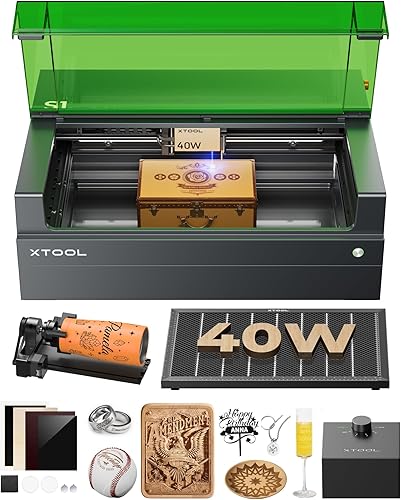
xTool S1 40W Laser Cutter and Laser: Best for large projects
- 40W laser
- 23.93 x 15.16 in bed
- 600mm/s speed
- Rotary bundle
The xTool S1 combines the highest stated laser power in this group with a large bed, fast engraving and a rotary bundle. It suits buyers planning large signs, tumblers or repeated craft jobs.
Pros
- 40W laser
- Large bed
- Rotary bundle
- Auto-focus
Cons
- 86.8 lb item weight
- Large projects need substantial workspace
The xTool S1 is the top pick for buyers who want a large laser machine with high stated power. Its 40W laser, 23.93 x 15.16 in bed and speed up to 600mm/s give it the strongest large-project profile in this group.
The rotary bundle adds a path for tumbler and other curved-surface work. That matters for names, logos or patterns that need to wrap around a cylinder instead of sitting flat.
xTool also lists auto-focus, XCS software, Pin-point Positioning and AutoPassthrough for projects up to 118 in. Auto-focus can reduce manual setup, while the longer project path suits work that runs beyond a standard flat bed.
The enclosed design has Class 1 safety, a protective cover that filters 99% of laser light, 5 flame sensors, an emergency stop and a lid-open stop feature. Those layers are useful when the machine will sit in a shared home or studio space.
At 86.8 lb, it needs a sturdy, planned workspace. Check the weight, footprint and lifting path before it arrives, not after.
Choose it for large signs, batches or buyers who want rotary capability included. This machine suits people who want one larger system for varied jobs rather than a small desktop engraver.
LONGER Ray5 Laser Engraver and Cutter Machine: Best for a large open work area
- 10W dual-beam laser
- 400 x 400mm work area
- 24,000mm/min speed
- Touchscreen control
The 10W Ray5 offers a square 400 x 400mm work area, touchscreen control and several connection options. It fits makers who value workspace and flexible operation over the highest cutting power.
Pros
- 400 x 400mm work area
- Touchscreen
- USB, TF card, Wi-Fi and app connectivity
Cons
- Less laser power than the 20W and 40W picks
- Open-machine safety setup needs careful planning
The 10W LONGER Ray5 is the strongest fit when a 400 x 400mm work area matters more than maximum laser power. That square workspace suits signs, home decor, gifts and larger flat blanks.
Its dual-beam laser has a stated 0.06 x 0.06mm spot and 0.01mm engraving accuracy. A fine spot helps with small text and detailed line work, where the laser needs to hold detail without spreading too far across the surface.
The machine reaches up to 24,000mm/min and supports wood, leather, acrylic and anodized metal work. Faster stated speed can shorten long engraving runs, though material, focus and settings still affect the result.
A 3.5-inch touchscreen handles progress and adjustments. That can be handy when you want to check a job without moving back to a computer.
USB, TF card, Wi-Fi and app connections give you several ways to send jobs, while LaserGRBL, LightBurn and LaserBurn support different workflows. Beginners can choose the simpler path, and experienced users can use the software they already know.
This is a good choice for a maker, classroom or small shop that values workspace and flexible control. For production needs, compare industrial laser cutters.
Its 10W output is less cutting-focused than the 20W Ray5 or xTool S1, so expect more emphasis on engraving and lighter cutting work.
ORTUR Laser Master 2 S2 LU2-10A Laser: Best for modular DIY setup
- 10W optical power
- 390 x 410mm engraving area
- 0.05 x 0.1mm compressed point
- Modular metal structure
The ORTUR Laser Master 2 S2 gives DIY users a modular metal machine with a near-square work area and a 10W laser module. It suits buyers who expect to assemble, repair or update parts themselves.
Pros
- Modular design
- LightBurn and LaserGRBL support
- Built-in air-assist interface
Cons
- Class 4 laser
- Safety setup requires close attention
The ORTUR Laser Master 2 S2 suits DIY users who value a modular metal structure and a 10W laser module. Its 390 x 410mm engraving area is close to the Ray5 10W size.
The compressed point is 0.05 x 0.1mm, and the machine has a built-in air-assist interface designed for cutting. Air assist can help clear smoke and debris from the cut path, which may leave cleaner edges on thicker material.
It supports LightBurn and LaserGRBL, with file support that includes SVG, DXF, JPG, JPEG, PNG, BMP and TIF. That range covers vector cuts, converted artwork and image-based engraving projects.
Assembly generally takes about 10 to 15 minutes. The modular design can make part replacement and updates more approachable, but it also means you need to pay attention during setup and maintenance.
Keep the frame squares, belts and guide surfaces in good order. Small alignment issues can show up as wavy lines or uneven detail, especially on longer runs.
This is a practical pick for buyers who want a repairable DIY-style machine. It is a Class 4 laser, so plan eye protection, enclosure needs and safe operating space carefully.
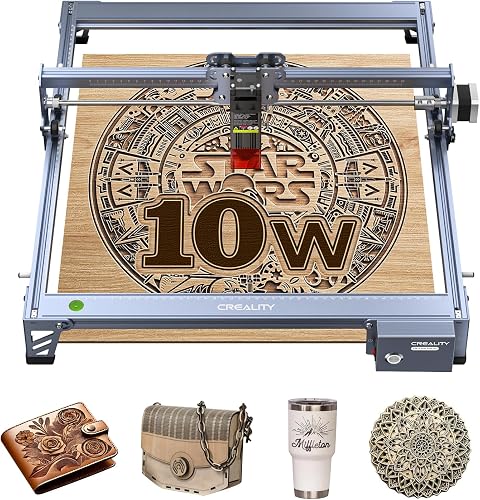
Creality Laser Engraver Machine 10W Output Power: Best for simple 10W cutting
- 10W output power
- 17 x 16 in stated size
- 0.06 x 0.06mm spot
- Wi-Fi, USB and SD card transfer
Creality pairs a 10W output with a fine spot and several ways to transfer files. It fits new users who want a familiar software path through LaserGRBL or LightBurn.
Pros
- 10W output
- Fine 0.06 x 0.06mm spot
- Fast assembly
Cons
- Lower stated speed than the fastest picks
- Open frame needs a suitable work area
Creality fits buyers who want simple file transfer and familiar software support. It works with LaserGRBL and LightBurn and accepts jobs through Wi-Fi, USB cable or SD card.
The 0.06 x 0.06mm spot supports detailed engraving, while the machine reaches up to 10,000mm/min. Fine detail matters on small lettering, logos and decorative lines that can blur when the spot is too wide.
Creality states that the 10W output can cut a 5mm basswood board or 3mm black acrylic in one pass under its stated conditions. For more material guidance, see how to choose a laser cutter for plastic.
Treat that as a guide for planning, then confirm your own results with a small test piece.
The all-aluminum structure and steel shaft wheel guide rail focus on stable movement. Steady motion helps keep curves smooth and repeated designs aligned across a job.
Assembly usually takes 10 to 20 minutes, and the laser head includes a focusing plate for adjustment without tools. Simple focus control lowers the barrier for first-time users who are still learning how depth changes the beam.
Choose it for wood, dark acrylic, leather and marking work when you want several connection options. Compare its stated size with the clear space around your table, including room for cables and safe access.
ACMER S1 Laser Engraver Machine: Best for compact craft spaces
- 2,500mW laser power
- 130 x 130mm working area
- 2kg weight
- 99% preassembled
The ACMER S1 is the smallest and lightest option here, with a 130 x 130mm work area and a compact aluminum design. It suits small engravings, limited desks and buyers who want quick setup.
Pros
- Compact size
- 2kg weight
- 99% preassembled
- Windows, macOS and Linux support
Cons
- Smallest working area here
- Lower laser power than the other main picks
The ACMER S1 is the best fit for small craft work in a limited space. It weighs 2kg, measures 250 x 250 x 162mm and has a 130 x 130mm working area.
Its 2,500mW diode laser reaches up to 10,000mm/min, with 0.01mm repeatable positioning accuracy. That makes it a better match for engraving and light cutting than for thicker, heavier cutting jobs.
The machine supports wood, bamboo, leather, plastic, PCB, aluminum oxide and ceramics, along with thin plywood, MDF and acrylic cutting. Small labels, tags and craft blanks fit this profile well.
The S1 arrives 99% preassembled, with a one-minute laser head installation. Quick setup is useful when you want to start with a simple test piece rather than spend time on assembly.
It supports macOS, Windows and Linux, plus LightBurn and LaserGRBL. That helps if you already use one of those programs or plan to move across systems later.
Pick it for small signs, tags, labels and personalized craft pieces. The compact bed is the main trade-off, so it is not the right match for large panels or broad batch layouts.
BlazeX M3 10W Laser Engraver Machine: Best for rotary tumbler work
- 10W laser
- Rotary roller and height risers
- Protective enclosure
- 13 materials and honeycomb bed
The BlazeX M3 is built around curved-object work, with a rotary roller, height risers and an enclosure included in the all-in-one kit. It suits tumbler projects and beginners who want several setup items together.
Pros
- Rotary set included
- Protective enclosure
- Honeycomb bed
- Class 1 safety rating
Cons
- 16.22 lb item weight
- Rotary setup adds more parts to manage
The BlazeX M3 is the strongest choice for rotary tumbler work from the box. Its 10W laser is paired with a rotary roller and height risers, which support 360-degree engraving on cylindrical objects.
The kit includes a protective enclosure, toolkit, 13 materials and a honeycomb laser bed. Having those items together can reduce separate shopping and help you test the setup soon after arrival.
BlazeX states 0.01mm precision and support for more than 300 materials, including wood, leather, glass and coated metal. Precision matters most on small text and curved surfaces, where alignment must stay consistent as the object turns.
Class 1 safety features include radiation filtering, a fan for smoke and odors, and sensors that stop the machine if it tilts or the lid opens. An enclosed setup can be easier to place in a home studio or classroom.
The machine works with LightBurn, LaserGRBL and CutLabX across Windows, macOS, iOS and Android. That range gives beginners a simpler entry point and gives experienced users a familiar control path.
Choose it when the rotary set and included workspace accessories matter. It has more parts to organize than a basic open-frame machine, but that setup can save separate accessory decisions.
LONGER Ray5 Laser Engraver and Cutter Machine: Best for higher-power Ray5 cutting
- 20W laser
- 400 x 365mm working area
- 24,000mm/min speed
- 3.5-inch touchscreen
The 20W Ray5 raises cutting power while keeping the Ray5 touchscreen and software options. It fits makers who need more cutting capacity than the 10W model but still want a large open work area.
Pros
- 20W laser
- 400 x 365mm work area
- Touchscreen control
- Full protective enclosure
Cons
- Different work area from the 10W Ray5
- Open-machine workflow needs careful safety planning
The 20W LONGER Ray5 is the better Ray5 choice for higher-power cutting with a large work area. Its 400 x 365mm area is slightly less square than the 10W model, while the 20W laser raises the cutting ceiling.
The machine reaches up to 24,000mm/min and has a stated 0.08 x 0.1mm spot with precision up to 0.01mm. That helps balance speed with the fine control needed for detailed engraving.
LONGER lists work with stainless steel, metal, wood, leather, glass, acrylic and cotton fabric. Wider material support can suit mixed craft and small-shop projects where one machine handles several blank types.
It keeps the 3.5-inch touchscreen, USB, TF card, Wi-Fi and app connections. On-screen progress checks can be useful during longer jobs, while the connection choices let you work from a computer, phone or stored file.
LightBurn, LaserGRBL and LaserBurn support give beginners and experienced users several workflow choices. Pick the software that matches your comfort level and the kind of files you already use.
Pick it when your projects need more cutting power than the 10W Ray5 provides. Choose the 10W model instead when a fully square 400 x 400mm layout is more useful than extra power.
Carverall K15 Pro Laser Engraver 10W Laser: Best for A4-size desktop work
- 10W power rating
- 11.8 x 7.9 in A4 workbed
- 15,000mm/min speed
- One-touch focus
The Carverall K15 Pro keeps the workbed near A4 size while adding one-touch focus, offline TF-card jobs and a stated 0.01mm precision. It suits compact desktop projects and small batch crafts.
Pros
- Compact A4 workbed
- One-touch focus
- Offline TF-card control
- Starter kit included
Cons
- Smaller work area than the Ray5 machines
- Bare-metal engraving requires the optional 1W IR head
The Carverall K15 Pro suits A4-size desktop work with quick focusing. Its 11.8 x 7.9 in workbed is compact, while one-touch focus and a stated 15,000mm/min speed support repeat craft jobs.
The 10W machine offers 0.01mm precision and works with wood, acrylic, leather and coated metal. Fine precision helps with jewelry blanks, tags and small branded pieces where detail carries the design.
Carverall also describes multi-pass cutting for 12mm plywood and 8mm acrylic. Multiple passes can be a practical way to handle thicker material when a single pass is not the best approach.
CutLabX works on computers, tablets and phones, and the machine supports LightBurn and LaserGRBL. Phone or tablet control can make short jobs easier to start, while desktop software suits more detailed editing.
TF-card control allows offline batch jobs, and the starter kit includes safety glasses, materials and tools. Offline control is useful when you want repeat work without keeping a computer tied to the machine.
The optional 1W IR laser head is the path Carverall gives for bare stainless steel tumblers and aluminum. Choose the K15 Pro when a compact A4 bed and upgrade path matter more than a large work area.
ATOMSTACK Swift 12W Laser Engraver and Cutter: Best for fast 300mm projects
- 12W laser output
- 300 x 300mm engraving area
- 400mm/s speed
- Magnetic protective cover
The ATOMSTACK Swift offers 12W output, a 300 x 300mm work area and speed up to 400mm/s. It fits buyers who want a middle-size machine for wood, metal and dark acrylic projects.
Pros
- 12W output
- 400mm/s speed
- 300 x 300mm work area
- LightBurn and LaserGRBL support
Cons
- Smaller bed than the Ray5 models
- Magnetic cover is removable
The ATOMSTACK Swift is a good match for fast 300mm projects. Its 12W output, 300 x 300mm engraving area and speed up to 400mm/s place it between compact desktop machines and larger Ray5 layouts.
The dual-compression spot measures 0.06 x 0.08mm and supports engraving on wood, metal and dark acrylic. A tighter spot can help with crisp lines, small lettering and contrast on detailed craft pieces.
Type-C and USB connections work with ATOMSTACK software, LightBurn, LaserGRBL and other control software. That flexibility helps if you prefer the maker brand app or already own a desktop program.
The removable magnetic protective cover and included safety glasses provide the stated eye-protection setup. A removable cover can be easier to lift for setup, but it also needs careful handling and correct placement during use.
The machine works with Windows, Mac and smartphones. Phone control can suit quick jobs, while a computer remains useful for larger files and detailed adjustments.
Choose it for personalized craft pieces, small business jobs and medium-size blanks. The 300 x 300mm area is useful for many projects, but it is smaller than both Ray5 work areas.
How much laser power do you need?
Laser power should match the materials and cutting depth you plan to handle. The xTool S1 leads at 40W, the LONGER Ray5 20W follows at 20W, and the ATOMSTACK Swift, BlazeX M3, Carverall K15 Pro, Creality, LONGER Ray5 10W and ORTUR use 10W to 12W levels.
Those middle-range machines suit engraving, marking and lighter cutting on common craft materials. Results still depend on material type, thickness, focus, speed and passes.
The ACMER S1 uses 2,500mW, or 2.5W, so it suits small engraving and light cutting. It can still be right when projects are small and desk space is tight.
A higher number does not replace correct focus, safe settings or material testing. Start with a small test piece, check edges and depth, then adjust before using a full blank.
Engraving often rewards fine detail and contrast, while cutting needs enough energy to pass cleanly through material. Think about your usual jobs first.
If you mostly engrave names and designs, lower power may be enough. If you cut thicker wood or acrylic often, move up in power or plan for multiple passes.
Safety scales with power too. Higher-power machines need more careful workspace planning, eye protection and smoke control.
Read the manual for your exact model before your first job.
Read what is a laser cutter and how does it work for the difference between engraving and cutting before choosing power.
Wattage is only one part of the decision. Work area, software and safety design can matter just as much in daily use.
Match power to projects you will actually run each week. That avoids paying for capacity you may not need.
Which work area fits your projects?
Work area is the clearest dividing line in this roundup. The LONGER Ray5 10W offers 400 x 400mm, the Ray5 20W offers 400 x 365mm, and the ORTUR offers 390 x 410mm.
Those larger areas suit signs, panels and batches where you can lay out several pieces at once. A square bed can help with symmetrical designs, while a wider rectangle may fit long blanks more naturally.
The xTool S1 has a 23.93 x 15.16 in bed, while the ATOMSTACK Swift has a 300 x 300mm area. The xTool bed is strong for large flat work, and the Swift sits in a middle range for medium craft blanks.
Carverall offers an 11.8 x 7.9 in A4 bed and ACMER offers a 130 x 130mm area. Both fit smaller blanks, tags and desktop projects where a large frame would be harder to place.
Measure your largest regular project, then leave room around the machine for cables, airflow and safe handling. The bed size alone does not tell you the full footprint you need on the table.
A smaller bed can be easier to place, but it may require moving or splitting larger designs. Splitting adds alignment work and can make borders or text harder to keep consistent.
A larger bed gives more layout freedom, but it also needs more clear space around it. Check doorways, shelves and nearby walls before you choose the biggest option.
Shape matters as much as size. A long narrow sign may fit better in one layout, while a wide panel may need a different orientation.
Rotary work changes the math too. Tumblers and bottles need height and turning space, not only flat bed dimensions.
Choose the work area that fits your common blanks, not only your biggest idea. Most daily work will benefit from a bed that feels comfortable and easy to load.
What safety features should you compare?
Safety features differ sharply between enclosed and open-frame designs. The xTool S1 and BlazeX M3 include enclosed safety elements, while several open machines rely on protective covers, goggles, sensors and a carefully planned workspace.
The ORTUR is a Class 4 laser with displacement, tilt and stopped-motion protections. Class 4 needs extra care, including strict eye protection and a controlled area where others will not wander into the beam path.
The xTool S1 lists Class 1 safety, 5 flame sensors, an emergency stop and lid-open stop. Those features support safer use in a shared space, but they still work best with a clear and steady setup.
BlazeX lists Class 1 safety, a protective enclosure and automatic stops for tilt or lid opening. An enclosure can also help contain smoke and reduce noise during routine jobs.
Other machines use covers, glasses or shields in different ways. The LONGER models list protective options, Creality lists a UV filter, and ATOMSTACK includes a removable magnetic cover with safety glasses.
Removable covers need attention because protection only works when the cover is in place. Store glasses where you will actually use them, and check that shields are seated before each run.
Sensors help, but they do not replace good habits. Keep the work area clear, stay nearby as directed, and never leave a job unattended unless the manual allows it.
Smoke and odor control belong in the safety plan from the start. Ventilation, a fan or an exhaust setup can make the room more comfortable and keep fumes away from people and pets.
Check the laser class for any machine you are considering. That label tells you how strict the safety setup needs to be.
Also confirm who can be in the room during a job. Kids and pets need the same protection from stray light, smoke and noise as adults.
A safer workspace is part of the machine choice, not an afterthought. Pick the design you can set up correctly every time.
Which machine should you choose?
Choose the xTool S1 40W if your priority is a large bed, high power, fast engraving and a rotary bundle. Choose the LONGER Ray5 10W for a 400 x 400mm work area, or the LONGER Ray5 20W when you want more cutting power in a similar format.
Pick the ACMER S1 for the smallest footprint, the BlazeX M3 for an included rotary tumbler setup, and the Carverall K15 Pro for A4 desktop projects with one-touch focus. The ATOMSTACK Swift fits medium-size 300mm work, while ORTUR and Creality suit DIY users who want flexible software and file-transfer choices.
For more kit-based comparisons, see our guide to best laser cutter kits. For wood-specific projects, compare the options in Best Laser Cutter For Wood, and use Best Laser Cutter For Acrylic when acrylic is your main material.
Our top 3 picks at a glance
-
1
-
2
Best for a large open work area
LONGER Ray5 Laser Engraver and Cutter Machine
9.3/10 our score
See it on Amazon -
3
Frequently asked questions
What is the best Bambu laser cutter for large projects?
The xTool S1 40W is the strongest large-project option in this group because it has a 23.93 x 15.16 in bed, 40W laser power and speed up to 600mm/s. Its rotary bundle also suits curved work.
Measure your available table before choosing this heavier machine.
Which Bambu laser cutter has the largest work area?
The LONGER Ray5 10W has the largest stated work area here at 400 x 400mm. The LONGER Ray5 20W follows with a 400 x 365mm area.
Choose by the shape of your usual blanks, since a square bed and a wider rectangular bed suit different layouts.
Are these laser cutters suitable for wood and acrylic?
Several picks support wood and acrylic work, including the xTool S1, LONGER Ray5 models, ORTUR, Creality, BlazeX, Carverall and ATOMSTACK. Cutting results depend on power, focus, material thickness and passes.
Start with the machine's safety guidance and a small test piece.
What should beginners check before buying a laser cutter?
Check the work area, laser power, software support, safety design and setup time first. A compact ACMER S1 needs less room, while the BlazeX M3 includes a rotary set and enclosure.
Open-frame machines require a carefully planned workspace and safe operating habits.
Can these machines engrave tumblers?
The xTool S1 includes a rotary bundle, and the BlazeX M3 includes a rotary roller with height risers for cylindrical objects. Other machines may need a separate rotary accessory.
Confirm the required setup, object size and material before starting a tumbler project.


