9 Best OMTech CO2 Laser Engraver (November 2026)
The best OMTech CO2 laser engravers include the xTool F1 Ultra 20W Fiber & Diode for mixed-material production, the xTool S1 40W Laser Cutter and Laser for large diode projects, and the xTool F2 5W IR & 15W Diode for portable customization.
On this page (5 sections)
The best OMTech CO2 laser engraver setup depends on your workshop goal. A larger CO2 machine gives you cutting space for sheets and signs, while a rotary attachment adds round objects to a machine you already own.
For a different format, compare CO2 galvo engravers.
A compact dual laser machine can be a better fit when metal marking and small batch work matter more than a wide bed. The right choice comes down to the jobs you plan to repeat each week.
This guide includes the OMTech accessories that support a CO2 workflow, plus machines that help you compare working areas, laser types and production needs. That mix matters because many buyers start with a CO2 goal and then learn that a diode, fiber or infrared source suits their materials better.
We checked the stated specifications and features, but we did not test these machines. We also did not rely on buyer reports or on claims beyond the product data in this guide.
Use the comparisons below to narrow the field before you look at footprint, ventilation and accessory needs in detail. A machine that looks strong on paper still needs space to load, unload and service.
If you are comparing the wider category first, see our guide to the Best CO2 Laser Engraver.
For the basic process, read how does a CO2 laser engraver work.
That background helps you judge why bed size, laser source and cooling are treated as separate decisions. It also helps you spot when a non CO2 machine is the more practical match for your workshop.
Start with your most common material and your largest regular piece. Those two answers will rule out several options faster than a long feature list.
Then check safety class, enclosure and exhaust needs for the room where the machine will live. A home room, a garage and a retail counter place different demands on the same laser.
Finally, check whether rotary work, long material support or batch production is part of your plan. Those needs often decide which accessory or machine size you should buy first.
Our picks at a glance
-
1
 Best for mixed-material production
xTool F1 Ultra 20W Fiber & Diode
9.6/10 our score
See it on Amazon -
2
-
3

- 4
 Best for home craft workflowsCheck it
- 5
 Check it
LaserPecker LP2 Laser Engraver with Roller
Best for handheld cylindrical work - 6
 Check it
OMTech Rotary Axis Attachment with 3-Jaw Chuck
Best for round-object engraving - 7
 Check it
OMTech CO2 Laser Coolant Non Conductive Liquid
Best for CO2 cooling maintenance - 8
 Check it
xTool P2S 55W CO2 Laser Cutter
Best for desktop CO2 production - 9
 Check it
Cloudray Ruida 6442S Panel for 6442S 6442G
Best for controller replacement
The best OMTech CO2 laser engraver options by use
The xTool P2S is the closest direct CO2 machine match, while the OMTech rotary axis and coolant solve important workshop needs around a compatible CO2 system. The other machines are useful comparisons when you need a diode, fiber or portable setup.
xTool F1 Ultra 20W Fiber & Diode: Best for mixed-material production
- 20W fiber laser
- 20W diode laser
- 220 x 220 mm working area
- 16MP camera
The F1 Ultra combines a 20W fiber laser for metals with a 20W diode laser for wood, acrylic, leather, glass, rubber and fabric. Its 220 x 220 mm work area suits small production pieces.
Pros
- Handles metal and common craft materials
- Supports 3D embossing and deep engraving
- 16MP camera for batch work
Cons
- Auto Conveyor is sold separately
- Class 4 laser requires careful safety planning
The xTool F1 Ultra is the most flexible pick for mixed materials because it combines a 20W fiber laser with a 20W diode laser. The fiber laser handles metals such as gold, silver, copper, stainless steel, brass and titanium, while the diode laser works with wood, acrylic, leather, glass, rubber and fabric.
Its 220 x 220 mm working area suits small products, jewelry work and personalization pieces. The area can expand to 220 x 500 mm with the separately available Auto Conveyor.
The built-in 16MP camera supports shape recognition for batch engraving. The machine reaches speeds up to 10,000 mm/s, and its diode laser can cut wood up to 15 mm and black acrylic up to 12 mm in the stated uses.
This is a Class 4 laser, so enclosure features, smoke extraction, the fire alarm and emergency stop still need to be part of your operating plan. Choose it when material range matters more than having a traditional CO2 bed.
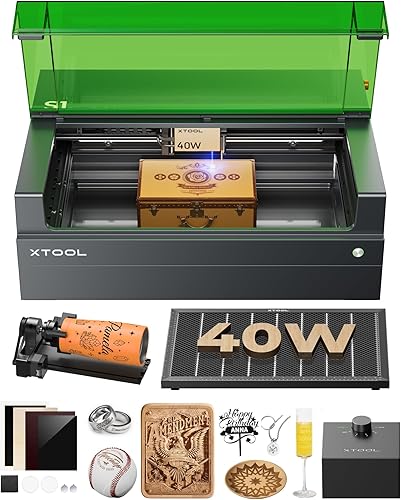
xTool S1 40W Laser Cutter and Laser: Best for large diode projects
- 40W laser
- 23.93 x 15.16 in bed
- 600 mm/s speed
- Rotary bundle
The S1 gives you a broad bed for signs and other large projects, with a 40W laser and a rotary bundle. It is a diode machine, so it is a different choice from a CO2 laser.
Pros
- Large working bed
- AutoPassthrough supports materials up to 118 in
- Class 1 enclosed design
Cons
- Not a CO2 laser
- Large footprint needs workshop space
The xTool S1 suits large diode projects with its 23.93 x 15.16 in bed and 40W laser. Its stated cutting ability reaches 18 mm cherry wood in one pass, while speeds reach 600 mm/s.
The bed gives you room for door signs and other broad layouts. AutoPassthrough supports projects up to 118 in long, and the rotary bundle adds a path for curved work.
That long material support is useful for planks, trim and signs that do not fit inside a smaller enclosure. It also means you need a clear path in front of and behind the machine during those jobs.
This is not an OMTech CO2 machine, but it is a useful alternative if your main need is a large enclosed diode workspace. Its Class 1 enclosure filters 99% of laser light, and the design includes 5 flame sensors, an emergency stop and a lid-open stop.
Those safety features suit a home or shared workshop where other people may be nearby. They do not remove the need to plan ventilation and supervision for wood smoke.
Choose the S1 when wood projects and a wide bed matter most. Choose a CO2 machine instead when your workflow depends on the CO2 laser source and its material behavior.
xTool F2 5W IR & 15W Diode: Best for portable customization
- 5W IR laser
- 15W diode laser
- 50MP camera
- 6000 mm/s speed
The F2 targets small pieces, on-site work and quick personalization. Its infrared laser marks metal, while the diode laser handles 3D embossing and thicker materials.
Pros
- Lightweight portable design
- 0.1 mm alignment accuracy
- Arrives fully assembled
Cons
- Smaller than a workshop CO2 machine
- Class 4 laser needs controlled operation
The xTool F2 is the best fit for portable small-batch customization because it weighs 10 lb and arrives fully assembled. Its 5W infrared laser marks metal, while the 15W diode laser handles 3D embossing and thicker materials.
A built-in 50MP camera gives up to 0.1 mm alignment accuracy on small pieces. The machine reaches speeds up to 6000 mm/s, and the Slide Extension can support batch layouts for items such as coasters and phone cases.
That camera accuracy matters most on small items where a small placement error is easy to see. It also helps when you need to repeat the same design across a tray of similar pieces.
The enclosed design includes a built-in fan, with an optional purifier for fumes. The box includes the F2 machine, base plate and base material kit.
Portability is the trade off here, because a light desktop unit cannot match the bed size of a workshop CO2 machine. Daily setup and pack down also take more care than leaving a large machine in place.
Pick it for fairs, markets, pop-ups and small pieces. It is not the right substitute for a large CO2 bed when you need broad signs or long sheet work.
xTool M2 10W Laser Engraver: Best for home craft workflows
- 10W diode laser
- Dual cameras
- Class 1 enclosure
- Base material kit
The M2 is a home-focused enclosed diode laser with dual cameras and a 10W output. It can work with wood, leather, felt, fabric and paper, while optional modules expand its workflow.
Pros
- Class 1 enclosed design
- Dual-camera workspace preview
- Base material kit included
Cons
- CMYK module is sold separately
- RA3 Lite Rotary is sold separately
The xTool M2 is the home-craft choice because its 10W diode laser sits inside a Class 1 enclosure with dual cameras. It works with cardstock, felt, leather, wood, fabric and paper, and its base material kit is included.
The cameras preview the workspace and support the Place & Go workflow. The M2 can also add a CMYK Inkjet module for full-color printing or a 3W IR laser for fine engraving on metal and plastic, but those modules are sold separately.
That modular approach keeps the base machine simpler for first jobs. It also means you should budget for the add on if color printing is a core goal rather than a later experiment.
Its software includes templates and an integrated AI image generator. The machine supports print-to-cut work when the CMYK module is added.
Templates help with stickers, tags and home decor where layout matters more than taking a design from scratch. Careful material choice still matters, because paper, felt and fabric respond differently to cutting and sealing.
Choose it for enclosed home projects, personalized gifts and a starting side hustle. It is less suited to a production shop that needs CO2 cutting power or a large work area.
LaserPecker LP2 Laser Engraver with Roller: Best for handheld cylindrical work
- Electric roller
- Portable handheld design
- 1417 in/min engraving speed
- 196 in maximum extended length
The LP2 is a portable engraver with an electric roller for cylindrical items such as tumblers and pencils. Its material limits make it better for coated surfaces than pure or shiny metal.
Pros
- Includes versatile electric roller
- Supports handheld engraving
- Includes protective cover and safety glasses
Cons
- Cannot engrave pure or shiny metal
- Wood and paper cutting is limited to 0.2 in thickness
The LaserPecker LP2 is a portable choice for cylindrical work because its electric roller supports cylinder, slab and trolley modes. The extended length reaches 196 in, while the width remains 4 in.
It engraves paper, cardboard, wood, leather, coated metal and brushed stainless steel. It cannot engrave pure or shiny metal, and its wood and paper cutting limit is 0.2 in.
Those material limits are the key trade off for this machine. Coated and brushed surfaces work within the stated scope, while bright metal will not give the same result.
The LP2 connects to a smartphone or PC and supports JPG, PNG and G-code files. The package includes the laser unit, electric roller, stand, protective cover, adapter, safety glasses, 2 Type-C cables and an English manual.
Handheld use adds flexibility for objects that are fixed in place. It also demands steady distance control, because the laser needs a consistent working distance for a clean mark.
Choose it when portability and roller work matter more than a CO2 workshop bed. Paint or spray light-colored or transparent material black before engraving, then wipe it after the job.
OMTech Rotary Axis Attachment with 3-Jaw Chuck: Best for round-object engraving
- 3-jaw chuck
- Tailstock
- 4-wire attachment cable
- Fits 50W and higher CO2 lasers
This OMTech rotary axis adds 360-degree engraving for cups, bottles, tubes, pipes, bowls and other round objects. It fits the listed 50W and higher CO2 machine sizes.
Pros
- 3-jaw chuck and tailstock
- 4-wire installation cable included
- Designed for cylindrical objects
Cons
- Requires a compatible CO2 laser
- Adds setup and software configuration work
The OMTech Rotary Axis Attachment is the most direct add-on for round-object work. Its 3-jaw chuck and tailstock hold cylindrical objects while the attachment turns them for 360-degree engraving.
It works with the stated 50W, 60W, 80W, 100W and 130W CO2 laser engraving machines. Suitable shapes include cups, bottles, tubes, pipes and bowls.
The chuck and tailstock combination is aimed at holding a piece firmly enough to turn it without slipping. Long or uneven pieces still need care during setup, because balance affects the finished mark.
Installation uses the included 4-wire attachment cable and the dedicated port on the laser engraver. You also need to configure the settings in your software before starting a rotary job.
That software step is easy to overlook and it changes how the machine treats curved work. A test on a practice piece helps you confirm size, centering and depth before you use a finished product.
The attachment measures 22.8 x 5.9 x 7.1 in and weighs 9 kg. For complete machine options with rotary support, compare CO2 engravers with rotary attachments.
Choose it when your compatible CO2 machine already handles flat work and you want to add round products.
OMTech CO2 Laser Coolant Non Conductive Liquid: Best for CO2 cooling maintenance
- 2 x 1 gal solution
- Prediluted coolant
- 10 µS/cm conductivity
- Protection to -31 F
This OMTech coolant supports CO2 laser cooling systems and is ready to add after cleaning the system with distilled or deionized water. Do not mix it with other coolants.
Pros
- Prediluted for immediate use
- Low conductivity
- Resists freezing, overheating and erosion
Cons
- Automotive antifreeze should not be used
- Mixing with other coolant may cause chemical reactions
OMTech's CO2 coolant is a maintenance choice for systems that use a water chiller or cooling tank. The prediluted solution comes in 2 x 1 gal containers and has ultra-low conductivity of 10 µS/cm.
The fluid helps protect CO2 laser tubes from freezing, overheating and erosion. It is designed to resist freezing to -31 F and can be used with CO2 laser machine water chillers and cooling tanks.
Low conductivity helps the cooling fluid do its job without adding electrical risk inside the system. That matters most when the chiller runs for long sessions and heat builds up in the tube.
Clean the water cooling system with distilled or deionized water before adding the coolant. Do not mix it with another coolant, and do not use automotive antifreeze because its viscosity and pH can damage laser output and tube life.
The cleaning step matters because old fluid and deposits can remain in lines and tanks. A full drain and rinse gives the new coolant a clean start.
Choose it as part of a CO2 maintenance plan, not as a substitute for a chiller, pump or laser tube. Check the cooling system instructions before filling it.
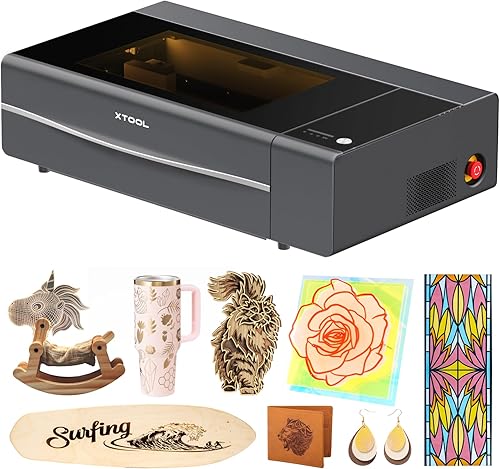
xTool P2S 55W CO2 Laser Cutter: Best for desktop CO2 production
- 55W CO2 laser
- 26 x 14 in bed
- 600 mm/s speed
- Dual 16MP cameras
The P2S is the strongest direct CO2 machine match in this group, with a 55W tube, 26 x 14 in bed and Auto-Passthrough for materials up to 118 in long.
Pros
- Large CO2 working area
- Cuts acrylic up to 20 mm in the stated use
- Supports rotary accessories
Cons
- 130.7 lb machine weight
- Class 4 laser requires controlled operation
The xTool P2S is the strongest direct CO2 pick here for workshop production. For more options, compare xTool CO2 laser engravers.
Its 55W CO2 laser works across a 26 x 14 in bed, with engraving speeds up to 600 mm/s.
The machine cuts all colors of acrylic up to 20 mm and black walnut up to 18 mm in one pass in the stated uses. Auto-Passthrough supports materials up to 118 in long, while the riser base allows objects up to 8.4 in high.
Dual 16MP cameras and LiDAR ranging support positioning and 0.001 in autofocus. The P2S also supports 3D curve engraving and is compatible with the RA2 Pro Rotary for tumblers, mugs and rings.
Those features suit shops that repeat named products and need consistent placement. Batch work with varied names or serial numbers also becomes easier when the machine can position each piece accurately.
At 130.7 lb, this is a substantial desktop machine. Choose it when bed size, CO2 cutting and repeat production matter more than portability.
Cloudray Ruida 6442S Panel for 6442S 6442G: Best for controller replacement
- 3.5 in color display
- Multi-language support
- 6442S and 6442G replacement panel
- Panel cable included
This Cloudray panel is a repair part for compatible 6442S or 6442G controller panels. It is not a complete controller set, so confirm the controller family before ordering.
Pros
- Replacement panel instead of a complete set
- Color display
- Multi-language support
Cons
- Only suitable for the stated controller family
- Not a complete 6442S controller set
The Cloudray Ruida 6442S panel is a repair part for a compatible 6442S or 6442G controller panel. It can help restore control without buying a complete controller set.
The panel has a 3.5 in color display with multi-language support. It measures 6.7 x 4.9 in and weighs 15.8 oz.
The package contains 1 panel with cable. Before ordering, confirm that your CO2 laser uses the 6442S or 6442G controller family.
That check matters because a replacement panel only helps when the controller family matches. A complete set is a different part and may be needed for a wider repair.
Cloudray notes that a loose display cable can also cause the LCD not to light, so inspect the connection during diagnosis. Choose this part when the controller family matches and the panel needs replacement.
It is not a full controller set.
Which working area fits your OMTech CO2 laser workflow?
A larger bed is better for signs, sheet layouts and batch work, while a smaller area can make sense for personalized pieces and limited shop space. The xTool P2S has the largest stated CO2 bed here at 26 x 14 in.
That size gives room to lay out several smaller parts at once and to cut sheets without tight framing. It also leaves less space for a compact workshop, so the machine footprint needs the same attention as the bed.
The OMTech rotary attachment changes the job shape rather than the flat bed size. It is designed for compatible 50W and higher CO2 machines and supports round objects such as cups, bottles and bowls.
Rotary work adds a new dimension to a flat bed workflow because the piece turns during engraving. Setup time and software settings become part of each job, especially for pieces that need careful centering.
For long work, the P2S Auto-Passthrough supports materials up to 118 in. The xTool S1 offers the same stated 118 in AutoPassthrough length, but it uses a 40W diode laser rather than CO2.
Long material support is useful for planks, trim and large signs, but it also changes the room layout. You need clear space for material to feed through without bending or blocking the path.
Measure the machine footprint, access path and working clearance before choosing a large unit. The P2S measures 44.09 x 29.13 x 13.78 in and weighs 130.7 lb.
Weight matters for placement, lifting and any future move to another room. A heavy desktop machine is still a fixed workshop fixture once it is in use.
Smaller machines suit jewelry, tags and personalized pieces where detail matters more than sheet size. They can also work well in a retail or market setting where space is limited.
The F1 Ultra offers 220 x 220 mm, which fits small production pieces rather than large signs. The window for expansion comes with the separately available Auto Conveyor.
Choose the bed size from your largest regular job, not from a one off idea. A bed that is too small will limit repeat work, while a bed that is too large can waste space.
Also consider how you load and unload pieces. Wide access, safe material handling and a clear path around the machine affect daily use as much as the stated bed size.
Should you choose CO2, diode or fiber?
Choose CO2 for a workshop that needs the P2S's stated cutting and engraving workflow on acrylic, wood, glass, ceramic, slate and coated metals. Choose diode for enclosed craft cutting and engraving, and fiber for direct metal work.
Infrared lasers add another option for metal marking, as seen in the F2 pairing of infrared and diode sources. That pairing suits portable customization where metal marking and embossing sit side by side.
The F1 Ultra combines fiber and diode lasers, making it the broadest material option in this roundup. Its fiber laser marks metals, while its diode laser works with wood, acrylic, leather, glass, rubber and fabric.
That dual source design reduces the need to own two machines for mixed material work. It does not replace a large CO2 bed when your main jobs are thick sheet cutting or large signs.
The S1 and M2 focus on diode workflows. The F2 combines infrared and diode lasers for metal marking, embossing and portable customization.
Each source has a different balance of material range, depth and portability. The best match depends on whether your shop sells metal pieces, wood products or a mix of both.
Read How Does a Laser Engraver Work? before comparing laser sources. If your projects focus on wood, our guide to the Best CO2 Laser For Wood covers that material choice in more detail.
What should you plan before buying a CO2 laser?
Plan the work area, safety setup, cooling method, smoke handling and material workflow before choosing a machine. A CO2 setup is more than the laser itself.
Start with the room where the machine will run each day. Check bench space, floor load, power access and a route for exhaust that does not leave smoke in the work area.
The P2S includes AI fire detection, an automatic lock, an emergency stop, adjustable air assist and a 233.3 CFM exhaust fan. The OMTech coolant is intended for the cooling system, while the rotary attachment is an optional path for cylindrical work.
Those features show why safety and support systems need to be planned as a set. Cooling, air assist and exhaust each affect the quality and safety of a cut in different ways.
A Class 4 machine needs controlled operation and careful setup. The F1 Ultra and P2S are both identified as Class 4 lasers, while the enclosed M2 is identified as Class 1.
That class difference affects where the machine can run and who should operate it. Enclosed designs help, but they do not remove the need for a clear operating plan.
Plan material storage and waste handling at the same time. Wood, acrylic and coated materials produce different smoke and offcuts, so the workflow needs space for sorting and safe disposal.
Also plan maintenance time for cleaning, filter care and cooling checks. A machine that runs daily will need a simple routine that fits the shop schedule.
For a smaller desktop comparison, see the Best Desktop CO2 Laser Engravers. Check the exact machine dimensions, power needs and accessory compatibility before ordering.
Confirm whether rotary work, long material support or batch production is part of your plan. Those needs often decide which accessory or machine size you should buy first.
The best OMTech CO2 laser engraver choice by buyer
The xTool P2S is the best direct CO2 machine choice here when you need a 55W laser, a 26 x 14 in bed and long-material support. Pair a compatible CO2 machine with the OMTech Rotary Axis Attachment when round-object engraving is central to your work.
Choose the OMTech coolant for routine CO2 cooling maintenance. Pick the xTool F1 Ultra if you need one machine that covers both metal marking and common craft materials, or the xTool M2 for an enclosed home craft workflow.
Each of those picks solves a different problem, so do not treat them as interchangeable. A rotary attachment adds curved work to a CO2 machine, while coolant supports the cooling system that the laser depends on.
The F1 Ultra suits shops that move between metal and craft materials without changing machines. The M2 suits a home user who wants an enclosed diode setup with cameras and templates.
For portable work, the F2 and LP2 take a different path based on weight and material limits. They suit small pieces and market settings where a large workshop bed is not the goal.
Our score weighs stated specs, features and buyer feedback against the needs of each use case. The right choice is the one whose laser type, working area and accessories match the jobs you plan to repeat.
Before you order, confirm the machine footprint, safety class, ventilation plan and accessory compatibility. Those practical details will shape daily use more than a single headline figure.
Our top 3 picks at a glance
-
1
Best for mixed-material production
xTool F1 Ultra 20W Fiber & Diode
9.6/10 our score
See it on Amazon -
2
-
3
Frequently asked questions
What is the best OMTech CO2 laser engraver for a workshop?
The best setup depends on your work area and production needs. The xTool P2S is the strongest direct CO2 machine match here, with a 55W CO2 laser and a 26 x 14 in bed.
Add the OMTech rotary axis if you need 360-degree work on round objects.
Check the machine footprint, ventilation plan and electrical requirements before choosing a workshop laser.
Is a diode laser the same as an OMTech CO2 laser engraver?
No. A diode laser and a CO2 laser use different laser sources and suit different workflows.
The xTool S1, F2 and M2 in this guide are diode or dual-laser machines, while the xTool P2S is a 55W CO2 machine.
Choose by the materials, cutting depth and work area you need.
What does the OMTech rotary axis do?
The OMTech rotary axis turns round objects during engraving, allowing 360-degree work on cups, bottles, tubes, pipes and bowls. Its 3-jaw chuck and tailstock hold the object while the laser works around its surface.
It fits the stated 50W, 60W, 80W, 100W and 130W CO2 laser machines.
Does CO2 laser coolant need to be mixed?
The OMTech coolant is prediluted and ready to use after the cooling system is cleaned with distilled or deionized water. Do not mix it with other coolants, and do not use automotive antifreeze in the laser system.
Follow your chiller and laser instructions for filling and maintenance.


