9 Best V Bits for CNC Routers (November 2026)
The best CNC router V bits include the SpeTool Carbide Chamfer End Mill V Groove for everyday sign lettering, the Whiteside Router Bits 1541 V-Groove 60-Degree 1/4-Inch for a defined cutting size, and the SILIVN CNC Wood Carving Router Bit for mixed engraving angles.
On this page (7 sections)
- The best cnc router v bits for lettering and signs
- What angle should you choose for a CNC router V bit?
- What shank size fits these CNC V bits?
- Are more flutes better for CNC engraving?
- How do you set up a V bit for clean lettering?
- What else should you buy for a CNC router setup?
- What are the best CNC router V bits for your projects?
The best cnc router v bits for most sign lettering are 60-degree carbide cutters with a 1/4 in shank, led here by the SpeTool and Whiteside 1541. A multi-angle set is more useful when your work includes fine outlines, broad grooves and different lettering sizes.
If you also need to flatten the work surface, compare CNC spoilboard surfacing bits.
V bits cut with angled sides that meet at a point. That shape makes them useful for lettering, sign borders, inlays, decorative lines and chamfered edges.
The angle changes the look: a smaller angle makes a narrower mark, while a larger angle opens the groove.
Before choosing a cutter, check your collet size, intended cutting depth and the width you want the groove to appear. Our guide to what is a CNC router machine explains the machine side, while what bits to use for a CNC router covers broader cutter choices.
Our picks at a glance
-
1
 Best for everyday sign lettering
SpeTool Carbide Chamfer End Mill V Groove
9.7/10 our score
See it on Amazon -
2
 Best for a defined cutting size
Whiteside Router Bits 1541 V-Groove 60-Degree 1/4-Inch
9.5/10 our score
See it on Amazon -
3
 Best for mixed engraving angles
SILIVN CNC Wood Carving Router Bit
9.4/10 our score
See it on Amazon
- 4
 Check it
Genmitsu 1/4'' V Grooving Router Bit Set
Best for 60 and 90 degree work - 5
 Check it
60 Degree V Groove Router Bit 1/4
Best for 3-flute engraving - 6
 Check it
uxcell 2 Pcs 30 Degree V Groove
Best for narrow detail lines - 7
 Best for broad 90-degree groovesCheck it
- 8
 Check it
90 Degree V Groove Router Bit 1/4
Best for simple 90-degree carving - 9
 Check it
90 Degree V Groove Router Bit Carbide
Best for 1/2-inch cutting width
The best cnc router v bits for lettering and signs
The best choice depends on the line width and angle you need most often. The 60-degree options are the strongest general picks here, while 30-degree and 90-degree cutters serve narrower jobs.
A useful way to separate the choices is by how much planning information each listing provides. The Whiteside 1541 states its cutting diameter and point length, while the Whiteside 1502 provides a cutting diameter, point length, shank and overall length.
Other entries focus more on angle, flute count or set format.
How we compared these V bits
We compared the stated angle, shank size, flute count, cutting diameter, point length, overall length and set format. We also considered how each profile fits common CNC jobs such as lettering, sign borders, decorative grooves and small detail work.
The score reflects specs, features and buyer fit for this search. It does not predict how a bit will perform with every machine, material or feed setting.
| Product | Best for | Angle | Shank | Flutes | Our score |
|---|---|---|---|---|---|
| SpeTool Carbide Chamfer End Mill V Groove | everyday sign lettering | 60 degrees | 1/4 in | 4 | 9.7 |
| Whiteside Router Bits 1541 V-Groove 60-Degree 1/4-Inch | a defined cutting size | 60 degrees | 9.5 | ||
| SILIVN CNC Wood Carving Router Bit | mixed engraving angles | 1/4 in | 9.4 | ||
| Genmitsu 1/4'' V Grooving Router Bit Set | 60 and 90 degree work | 1/4 in | 9.2 | ||
| 60 Degree V Groove Router Bit 1/4 | 3-flute engraving | 60 degrees | 1/4 in | 3 | 9.0 |
| uxcell 2 Pcs 30 Degree V Groove | narrow detail lines | 30 degrees | 1/4 in | 8.9 | |
| Whiteside 1502 V Groove | broad 90-degree grooves | 90 degrees | 8.8 | ||
| 90 Degree V Groove Router Bit 1/4 | simple 90-degree carving | 90 degrees | 1/4 in | 8.6 | |
| 90 Degree V Groove Router Bit Carbide | 1/2-inch cutting width | 90 degrees | 1/4 in | 8.4 |
SpeTool Carbide Chamfer End Mill V Groove: Best for everyday sign lettering
- 60-degree V groove
- 4 flutes
- 1/4 in shank
- Carbide chamfer end mill
A 60-degree carbide V groove bit with 4 flutes and a 1/4 in shank suits common lettering and sign work where a defined point and clean angled walls matter.
Pros
- 4-flute cutting design
- 1/4 in shank
- Useful 60-degree angle
Cons
- No cutting diameter stated
- No point length stated
The SpeTool Carbide Chamfer End Mill V Groove Router Bit is the strongest all-purpose pick in this group because it combines a 60-degree angle, 4 flutes and a 1/4 in shank. That combination suits common CNC routers and sign projects that need a clear V profile without moving to a very broad groove.
The 60-degree angle is a useful middle ground. It can create visible lettering and decorative lines while staying narrower than a 90-degree cut.
Four flutes give the cutter a defined multi-edge design, although the title does not state a cutting diameter or point length, so measure your toolpath needs separately.
Choose this bit when you already know that 60 degrees fits most of your work. It is less flexible than the SILIVN set, which includes 5 angles, but it is more focused than buying a collection you may rarely use.
It also has a more specific cutting design than the listings that only identify a general carbide V bit.
The 1/4 in shank must match your router collet. Set a conservative first pass, secure the workpiece, and confirm the preview shows the groove width you expect before cutting the final board.
Because the cutting dimensions are not stated, a proof cut is especially important for lettering with tight spacing.
Whiteside Router Bits 1541 V-Groove 60-Degree 1/4-Inch: Best for a defined cutting size
- 60-degree V groove
- 1/4 in cutting diameter
- 7/32 in point length
The stated 1/4 in cutting diameter and 7/32 in point length make this a clear choice when those dimensions need to fit your lettering layout.
Pros
- Known cutting diameter
- Known point length
- 60-degree angle
Cons
- Flute count not stated
- Shank size not stated in the title
The Whiteside Router Bits 1541 is a strong choice when you want a 60-degree V bit with two useful cutting dimensions stated directly: a 1/4 in cutting diameter and 7/32 in point length. Those measurements help you compare the cutter with lettering size, pocket depth and the space between nearby details.
A 60-degree angle gives this bit the same general profile as the SpeTool, but the stated diameter and point length make the Whiteside easier to plan around when your design has tight spacing. The title does not state the shank size or flute count, so confirm those details for your router before ordering.
This bit suits sign makers who prefer a defined cutter size over a multi-angle set. It is less flexible than SILIVN or Genmitsu, but a single known profile can simplify repeat work.
It is also easier to compare with another toolpath when the cutting diameter and point length are already part of the product data.
Use a test area from the same material before cutting the finished sign. Your V-bit preview should account for the actual angle and point behavior, not just the lettering font.
If the design contains narrow internal spaces, the known dimensions can help you decide whether the letters need more room.
SILIVN CNC Wood Carving Router Bit: Best for mixed engraving angles
- 15, 20, 30, 60 and 90 degree bits
- 1/4 in shank
- Blue nano-coating
- 5-count set
- Independent storage case
Five angles cover fine detail, outlining, general engraving and V grooves, so this set suits users who do not want to commit to one profile.
Pros
- Five engraving angles
- 1/4 in shank
- Independent storage case
Cons
- More setup choices to manage
- Individual cutting dimensions vary by bit
The SILIVN CNC Wood Carving Router Bit set suits users who work across several engraving styles. It includes 15, 20, 30, 60 and 90 degree bits, all in a 1/4 in format, with blue nano-coating and an independent storage case for each bit.
The angle range is the main reason to choose it. The 15-degree bit is aimed at detail carving, the 20-degree bit at outlining, the 30-degree bit at general engraving, and the 60- and 90-degree bits at V grooves.
SILIVN also describes the set as having 2-flute straight and V-bit tools, and the product data identifies a 5-count set.
This is more adaptable than any single-angle pick here. The trade-off is that you must choose the right profile for each design and keep the bits organized.
A set also does not give one universal cutting width because each angle serves a different purpose. That makes it useful for varied work, but less direct when a repeat job always needs the same profile.
Pick it for a mixed project queue. Move slowly during setup, check the toolpath preview, and use the independent cases to keep the angles from being confused.
The 1/4 in shank keeps the set aligned with the common format used by most of the other picks here.
Genmitsu 1/4'' V Grooving Router Bit Set: Best for 60 and 90 degree work
- 60-degree bit
- 90-degree bit
- 1/4 in V grooving set
- VG03A
This two-angle set keeps the choice focused: use 60 degrees for narrower lettering and 90 degrees for wider grooves or decorative cuts.
Pros
- Two useful angles
- 1/4 in format
- Simple set choice
Cons
- Only 2 angles
- Cutting dimensions not stated
The Genmitsu VG03A set keeps the choice simple with 60-degree and 90-degree V grooving bits in a 1/4 in format. It suits a CNC owner who wants two common profiles without managing a larger engraving set.
Use the 60-degree bit when the design needs a narrower, more pointed groove. Move to the 90-degree bit for broader decorative lines and open V shapes.
This angle pair covers many sign and wood engraving jobs, but the product title does not state cutting diameter, point length or flute count, so those details should not be assumed during toolpath planning.
Compared with the SILIVN set, Genmitsu offers fewer angles and a simpler decision. Compared with a single SpeTool or Whiteside 60-degree cutter, it adds a second profile for wider work.
That makes it a practical middle option when one angle feels limiting but five choices would add unnecessary setup.
This set fits beginners who understand the basic difference between narrow and broad V cuts. Label the bits after unpacking if the markings are small, then run a shallow proof cut before committing to a finished sign.
Check both profiles separately because the same depth setting will not create the same visual width at each angle.
60 Degree V Groove Router Bit 1/4: Best for 3-flute engraving
- 60-degree V groove
- 3-flute design
- 1/4 in shank
- Nano blue coated solid carbide
A 60-degree profile, 3-flute design and 1/4 in shank give sign makers a focused option for engraving and chamfering.
Pros
- Solid carbide construction
- 3 flutes
- Nano blue coating
Cons
- One angle only
- Cutting diameter not stated
This 60 Degree V Groove Router Bit is a focused option for CNC engraving and chamfering. It combines a 3-flute design, 1/4 in shank and nano blue coated solid carbide construction around one common 60-degree profile.
The 3-flute design gives this cutter a different configuration from the 4-flute SpeTool. That difference may matter when you compare toolpath settings, but the product data does not state a cutting diameter, overall length or point length, so those dimensions should not be added to your plan without confirmation.
Choose it when your projects mostly use 60-degree lettering and you want a single-purpose cutter. It is less adaptable than the SILIVN and Genmitsu sets, but a dedicated bit keeps your angle choice consistent from one sign to the next.
Its solid carbide construction and nano blue coating are also stated features, while the actual cutting width still needs to be treated as unknown.
It also works for chamfering, where the angled cutter removes material from an edge to create a sloped transition. Secure the stock, keep the first pass conservative and inspect the edge before increasing depth.
If your design changes often, compare its focused format with a multi-angle set before choosing.
uxcell 2 Pcs 30 Degree V Groove: Best for narrow detail lines
- 2 pieces
- 30-degree angle
- 3 flutes
- 1/4 in shank
- Nano-coated carbide
The narrow 30-degree angle is suited to fine engraving lines and small lettering, while the 2-piece format gives you a spare matching bit.
Pros
- Narrow 30-degree profile
- 2 pieces
- 3-flute design
Cons
- Less suited to broad grooves
- Cutting diameter not stated
The uxcell 2 Pcs 30 Degree V Groove set is aimed at narrow detail lines and small engraving work. Its 30-degree profile, 3-flute design, 1/4 in shank and nano-coated carbide construction make it more specialized than the 60-degree picks above.
A 30-degree V creates a tighter-looking line at comparable depth, which can help with fine outlines and detailed lettering. It is not the natural first choice for broad decorative grooves because a narrow angle concentrates the cut into a smaller profile.
The narrower shape can therefore suit compact details, but it does not replace a 90-degree cutter when the design needs a broad, open mark.
The 2-piece format gives you matching cutters rather than several different angles. That can be useful for repeat work where keeping a spare on hand matters, though the product title does not state the cutting diameter or overall length.
The two-piece format also keeps the choice focused compared with SILIVN or Genmitsu.
Choose uxcell when fine detail is more important than profile range. Preview the toolpath at the final size because a line that looks clear on a large sign may become too small or fragile on a compact design.
Confirm that the 1/4 in shank suits your collet before setting the bit.
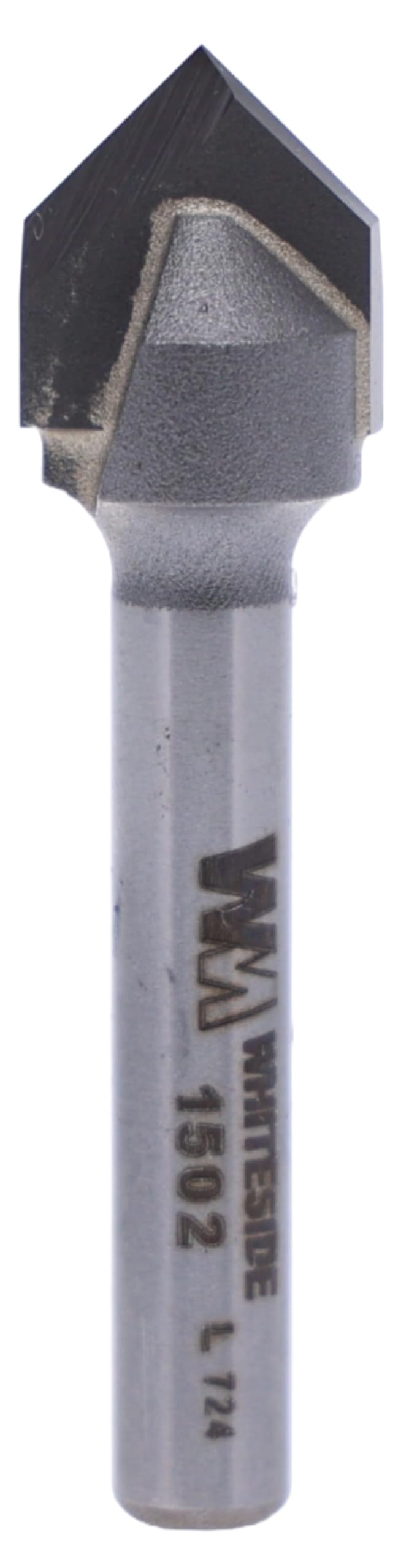
Whiteside 1502 V Groove: Best for broad 90-degree grooves
- 90-degree included angle
- 1/2 in cutting diameter
- 1/4 in point length
- 1/4 in shank
- 1-7/8 in overall length
The 90-degree angle and 1/2 in cutting diameter suit broad grooves and strong decorative lines where a narrow lettering point is not the goal.
Pros
- Known cutting diameter
- Known overall length
- 1/4 in shank
Cons
- Broader profile than a 60-degree bit
- Less suited to fine narrow lettering
The Whiteside 1502 suits broad decorative grooves because it has a 90-degree included angle and 1/2 in cutting diameter. Its 1/4 in point length, 1/4 in shank and 1-7/8 in overall length also give you several dimensions to check against your router clearance and project depth.
A 90-degree angle opens the groove more than a 60-degree bit. That makes it useful for large lettering, wide borders and decorative cuts where a narrow pointed mark would not have enough visual weight.
The broad profile can make a simple design easier to read, but it may overwhelm small letters or tight internal spaces.
The 1/2 in cutting diameter is another reason to plan carefully. Compare the cutter with your machine's available clearance and the width of the design before starting.
The overall length helps with reach, but it does not replace checking the router's working envelope. The stated point length also matters when the design depends on a defined tip.
Choose this over the smaller 90-degree options when the stated cutting diameter and length fit your setup. Choose a 60-degree bit instead when your sign needs tighter lettering or finer lines.
Its 1/4 in shank remains compatible with the common format described across this roundup.
90 Degree V Groove Router Bit 1/4: Best for simple 90-degree carving
- 90-degree V groove
- 1/4 in shank
- Carbide insert
- Wood CNC router bit
This focused 90-degree bit suits wood engraving and carving when you want one broad V profile in a 1/4 in shank format.
Pros
- 90-degree profile
- Carbide insert
- 1/4 in shank
Cons
- One angle only
- Cutting diameter not stated
This 90 Degree V Groove Router Bit is a straightforward choice for wood CNC engraving and carving. It uses a 1/4 in shank and carbide insert, with one broad 90-degree profile rather than a set of angles.
The 90-degree shape is suited to open grooves, bold decorative lines and broad lettering. It is less suited to very fine detail than a 30-degree bit, and it does not offer the angle choice of the SILIVN or Genmitsu sets.
Its single-profile format can still be useful when your project list consistently calls for a wide V cut.
Its carbide insert is the key construction detail given for this product. The title does not state cutting diameter, point length, flute count or overall length, so keep the design conservative until those dimensions are confirmed for your specific tool.
Do not infer that it has the same cutting width as either 1/2 in 90-degree option in this guide.
This bit fits a buyer who wants one 90-degree option for wood projects. Check the 1/4 in shank against your collet, clamp the material firmly and use a shallow first pass to verify the groove before full-depth cutting.
A proof cut is the clearest way to judge whether its broad profile suits your lettering.
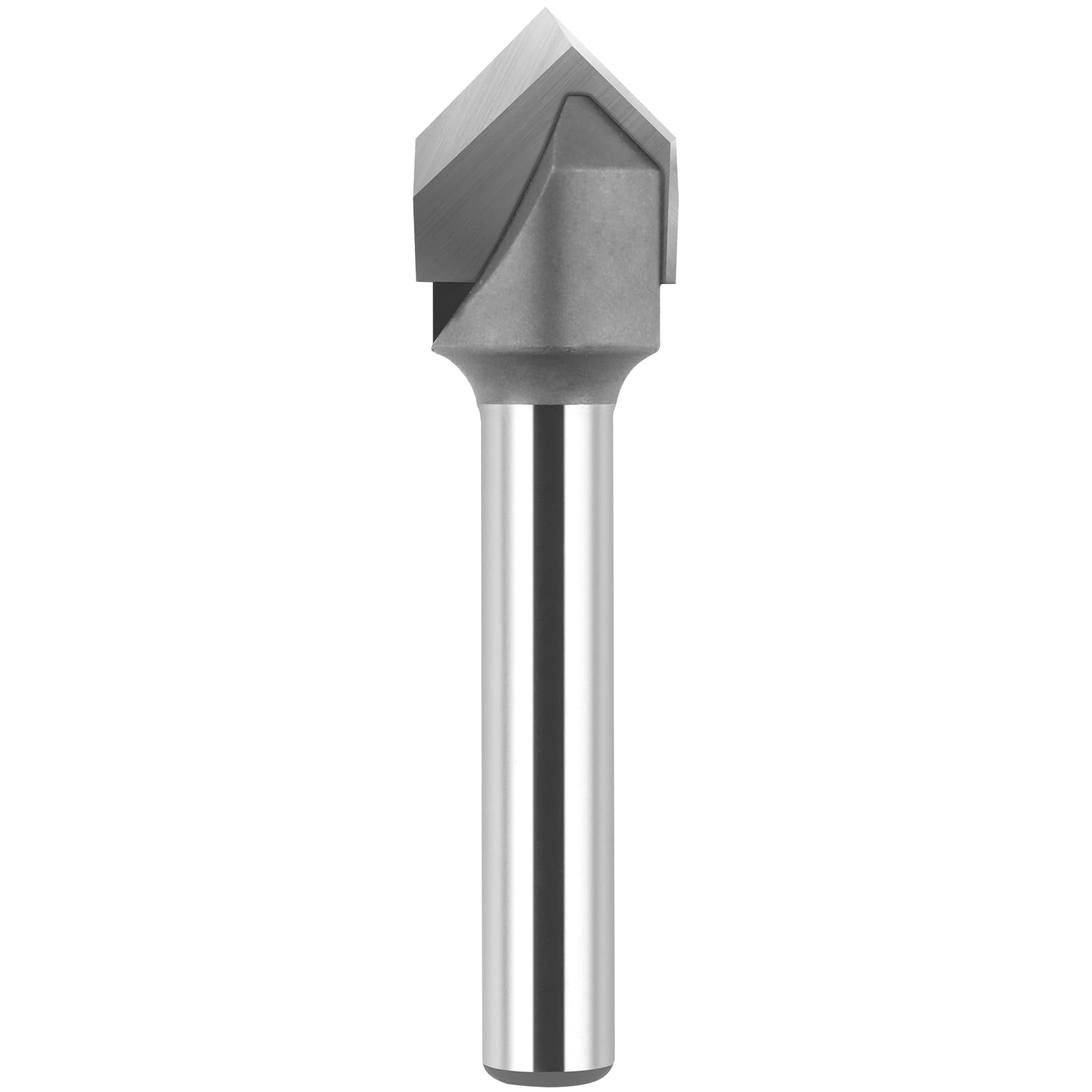
90 Degree V Groove Router Bit Carbide: Best for 1/2-inch cutting width
- 90-degree V groove
- Carbide
- 1/4 in shank
- 1/2 in cutting diameter
A 90-degree carbide profile with a 1/2 in cutting diameter fits broad V grooves and chamfer-style work when your router setup accepts a 1/4 in shank.
Pros
- 1/2 in cutting diameter
- 90-degree profile
- Carbide construction
Cons
- One angle only
- Overall length not stated
The 90 Degree V Groove Router Bit Carbide is another broad-profile option, with a 1/2 in cutting diameter and 1/4 in shank. It suits CNC woodwork where a wide V groove or chamfer-style cut is more useful than narrow lettering.
The stated 1/2 in diameter makes this easier to compare with the Whiteside 1502. Both are aimed at broad work, but the Whiteside also states a 1/4 in point length and 1-7/8 in overall length.
This cutter gives you the key diameter and shank details without those extra dimensions. The shared 90-degree angle means both are more open than the 60-degree options.
Choose it when the 90-degree angle and 1/2 in cutting diameter match your design. It is less flexible than a 2-angle set and less suited to small lettering than a 60-degree or 30-degree profile.
It can be a sensible focused choice when you already know that a broad cut is the main requirement.
Before cutting, confirm that your machine has room for the cutter and that the collet accepts the 1/4 in shank. A proof cut helps show whether the wide profile matches the visual weight of your lettering.
Because overall length is not stated, leave enough clearance in the setup and confirm the fit before starting.
What angle should you choose for a CNC router V bit?
Choose 30 degrees for narrow detail, 60 degrees for general lettering, and 90 degrees for broad grooves. The same angle also changes how quickly the visible groove widens as cutting depth increases.
The angle is only part of the decision. Cutting diameter, point length and overall length affect how the cutter fits the design and machine, so a nominally suitable angle may still be the wrong choice if its dimensions do not fit.
30-degree V bits
The uxcell pair is the specialist option here. A narrow angle suits small outlines and detail work, but it may not give broad lettering enough visual weight.
60-degree V bits
The SpeTool, Whiteside 1541 and 3-flute 60-degree cutter are the strongest general choices. This angle balances a pointed look with a groove that remains easy to see on many signs.
90-degree V bits
The Whiteside 1502, Genmitsu option, 90 Degree V Groove Router Bit 1/4 and 90 Degree V Groove Router Bit Carbide suit wide decorative cuts. Their open profile is easier to see at a glance, but it can look too broad on small lettering.
What shank size fits these CNC V bits?
Every product in this roundup is described with a 1/4 in shank, except the Whiteside 1541, whose title does not state the shank size. Your router collet must match the bit shank exactly.
A 1/4 in shank is common on compact CNC routers, but compatibility still depends on the collet installed in your machine. Check the collet before ordering and never force a bit into a mismatched opening.
The shank does not tell you whether the cutting end will fit the job. A 1/2 in cutting diameter, for example, needs more room in the design and setup than a listing with no stated diameter.
Check the cutting end separately from the collet connection.
For machine selection, our guide to best CNC router bits for wood explains how cutter shape affects wood projects. If you need extra reach rather than a V profile, see best long CNC router bits.
Are more flutes better for CNC engraving?
More flutes are not automatically better because flute count is only one part of the cutting setup. The products here range from 2-flute information on the SILIVN set to 3-flute and 4-flute designs, while several titles do not state flute count.
Use the flute count as a comparison point, not as a promise of a particular finish. Feed rate, depth per pass, material, router speed and workholding also affect the cut.
A 4-flute design may appeal to a buyer comparing the SpeTool with the 3-flute 60-degree and uxcell options. However, you still need settings that match the cutter and material rather than copying one number across every bit.
Flute count also should not override the angle decision. A 3-flute 30-degree bit may be a better fit for narrow detail than a 4-flute 60-degree bit, while a 90-degree cutter may be the right choice for a broad border regardless of the stated flute count.
How do you set up a V bit for clean lettering?
Start with a secure workpiece, a matching collet and a shallow proof cut. Then inspect the line width, corners and depth before cutting the final sign.
The proof cut should use the same material and a representative part of the design. This lets you check whether the chosen angle produces the intended visual weight before the complete board is committed.
Preview the V-bit toolpath
The cutter angle affects the visible groove. Previewing helps you catch lettering that is too narrow, too wide or too deep for the stock.
Use multiple passes when needed
A shallow first pass reduces the risk of committing the full design before you know how the material responds. Increase depth only after checking the proof area.
Keep the surface level
A V bit changes visible width when the material surface rises or falls. Flatten the work area as needed and keep the material firmly clamped.
Clear chips safely
Stop the machine before removing chips or adjusting the stock. Do not reach near a rotating cutter, and follow your router's safety instructions.
What else should you buy for a CNC router setup?
A V bit handles the cut, but a stable setup also needs workholding and suitable controls. See our guide to best CNC router clamps if movement is affecting your lines, and compare best CNC router controllers and controller kits when you need to review the control side.
A starter setup should also include a way to verify the collet, a flat work surface and a method for checking the finished depth. Keep bits in their cases or a protected holder so the points do not strike other tools.
The cutter's stated dimensions should also shape the setup. A 1/2 in cutting diameter needs more clearance than an unspecified cutting diameter, while a longer overall length may affect how far the bit extends from the collet.
Confirm those details before mounting the bit.
If you're choosing the machine as well as the cutter, our guide to best FoxAlien CNC routers can help you compare that brand's router options. The machine, collet and workholding must all support the bit you choose.
What are the best CNC router V bits for your projects?
The SpeTool 60-degree bit is the best cnc router v bit for most everyday lettering, while the Whiteside 1541 is a better fit when its stated cutting diameter and point length help you plan the design.
Pick SILIVN if you need 5 engraving angles, Genmitsu if 60 and 90 degrees cover your work, and uxcell if narrow 30-degree detail is the main job. For broad grooves, choose the Whiteside 1502 or one of the 1/2 in 90-degree options.
The right V bit is the one whose angle, shank and cutting dimensions match your design and router. Start with a proof cut, then move to the final material once the groove width and depth look right.
Our top 3 picks at a glance
-
1
Best for everyday sign lettering
SpeTool Carbide Chamfer End Mill V Groove
9.7/10 our score
See it on Amazon -
2
Best for a defined cutting size
Whiteside Router Bits 1541 V-Groove 60-Degree 1/4-Inch
9.5/10 our score
See it on Amazon -
3
Best for mixed engraving angles
SILIVN CNC Wood Carving Router Bit
9.4/10 our score
See it on Amazon