9 Best Laser Safety Glasses for CO2 Lasers (November 2026)
The best laser safety glasses for CO2 lasers include the LP-LaserPair LaserPair Laser Safety Glasses 200-534nm for broad wavelength coverage, the Cloudray CO2 Laser Safety Glasses for 10600nm CO2 lasers, and the Cloudray CE 1064nm Laser Safety Goggles Protective for fiber laser work.
On this page (3 sections)
The best laser safety glasses for CO2 lasers are the Cloudray CO2 Laser Safety Glasses because they state OD 6+ protection for 10600nm and 50% visible light transmission.
That combination matters in a working shop where you need to see the material, the cut line and the machine controls without lifting the eyewear.
CARLANY is the better fit for a wider 9000–11000nm range, while LaserPair suits mixed work across several visible and near-infrared bands.
CO2 lasers need wavelength-specific eye protection. A pair designed for 1064nm fiber work or 405nm blue light should not be treated as a 10600nm CO2 solution.
The wavelength is the first filter for every choice in this guide. Frame shape, colour and price come after that basic match.
A darker lens alone does not tell you whether the filter blocks the wavelength your machine produces. Always check the stated protection range against the machine specification.
For a standard CO2 engraver or cutter, 10600nm is the number to look for in the product data. It may also appear as 10.6um.
Optical density then tells you how strongly the covered wavelength is attenuated. A higher OD is not a substitute for the wrong wavelength range.
Visible light transmission tells you how bright the view will feel in daily use. Higher VLT can make alignment and inspection easier, but it does not change the protection range.
Fit also affects whether you will wear the glasses for a full session. A strap, over-glasses frame or wrap-around shape may suit different users and different workspaces.
Storage and cleaning matter because damaged lenses cannot be assumed to protect as intended. Keep the pair in its box or case and follow the care notes for that model.
If your workspace has one CO2 machine, start with the dedicated CO2 options. If it has several laser types, the mixed-work options may deserve a closer look.
If you also use other engraving systems, compare our Top 8 Best Laser Safety Glasses for Engraving guide.
For general questions about eyewear, read Do You Need Safety Glasses for a Laser Engraver?.
That background helps you separate a general engraving eyewear choice from a CO2-specific one. It also helps a second user in the shop make the same wavelength check.
Use the guides as a starting point, then verify the exact wavelength and protection details before any session. The safest choice is the one whose stated range matches your machine.
Our picks at a glance
-
1
 Best for broad wavelength coverage
LP-LaserPair LaserPair Laser Safety Glasses 200-534nm
9.7/10 our score
See it on Amazon -
2

-
3
 Best for fiber laser work
Cloudray CE 1064nm Laser Safety Goggles Protective
9.6/10 our score
See it on Amazon
- 4
 Best for xTool mixed laser setupsCheck it
- 5
 Check it
ULTREMA Laser Safety Glasses IPL 200-2000nm
Best for broad low-to-mid wavelength use - 6
 Check it
Comgrow 2 Packs Laser Safety Glasses Laser
Best for shared workspaces - 7
 Check it
JILERWEAR IPL Professional Safety Glasses Laser Protection
Best for IPL and workshop crossover - 8
 Check it
GOSONO 2 SET Goggles Laser Safety Glasses
Best for two users on a budget - 9
 Check it
CARLANY CO2 Laser Safety Glasses OD 5+
Best for wide CO2 wavelength coverage
The best laser safety glasses for CO2 lasers
Cloudray is the strongest dedicated pick for a standard 10600nm CO2 engraver or cutter.
Its stated OD 6+ protection and 50% visible light transmission give a balance of CO2-specific coverage and a workable view of the job. That balance is the reason it leads the dedicated CO2 choices.
The other choices cover broader ranges, different laser types or shared workspaces, so check your machine before choosing from the list.
A broader range can be useful in a mixed shop, but breadth does not automatically include 10600nm. Read the upper end of the range, not only the lower end.
Our score weighs stated wavelength coverage, optical density, visible light transmission, fit details and buyer feedback against the needs of someone shopping for CO2 laser protection.
In practice, wavelength coverage should outweigh every other factor. A comfortable frame with the wrong filter is still the wrong eyewear for a CO2 machine.
Optical density is the next check once the wavelength matches. It describes attenuation at the covered wavelength, so compare it only within the correct range.
Visible light transmission affects how easily you can see the workpiece and the machine. A brighter view can reduce the temptation to remove the glasses mid-task.
Fit details matter for longer sessions and for users who wear prescription glasses. An adjustable strap or over-glasses design may change how the eyewear feels over time.
Storage, cleaning and inspection habits also belong in the decision. The right pair needs to arrive in good condition and stay that way between uses.
Use the ranking as a shortlist, then confirm the details for your exact machine. That final check keeps a general guide from becoming a guess.
| Product | Best for | Protection range | Visible light transmission | Frame and lens | Our score |
|---|---|---|---|---|---|
| LP-LaserPair LaserPair Laser Safety Glasses 200-534nm | broad wavelength coverage | 180–534nm, 740–900nm and 900–1095nm | 23% | TR90 frame and polycarbonate lens | 9.7 |
| Cloudray CO2 Laser Safety Glasses | 10600nm CO2 lasers | 50% | 9.6 | ||
| Cloudray CE 1064nm Laser Safety Goggles Protective | fiber laser work | 30% | 9.6 | ||
| xTool Laser Safety Glasses | xTool mixed laser setups | 316–450nm and 900–1080nm | 9.4 | ||
| ULTREMA Laser Safety Glasses IPL 200-2000nm | broad low-to-mid wavelength use | 200–2000nm | 15% | 9.3 | |
| Comgrow 2 Packs Laser Safety Glasses Laser | shared workspaces | Polycarbonate | 9.2 | ||
| JILERWEAR IPL Professional Safety Glasses Laser Protection | IPL and workshop crossover | 200–1200nm | 60% | 9.1 | |
| GOSONO 2 SET Goggles Laser Safety Glasses | two users on a budget | 190–540nm | 9.0 | ||
| CARLANY CO2 Laser Safety Glasses OD 5+ | wide CO2 wavelength coverage | 9000–11000nm | >90% | 8.1 |
LP-LaserPair LaserPair Laser Safety Glasses 200-534nm: Best for broad wavelength coverage
- 180–534nm OD 7+
- 740–900nm OD 5+
- 900–1095nm OD 7+
- 23% visible light transmission
- Wrap-around polycarbonate lenses
LaserPair is the broadest multi-wavelength option here, covering visible, near-infrared and infrared ranges. It is better suited to mixed laser work than to a CO2-only setup.
Pros
- Broad protection range
- CE, EN207 and A1EN207 certifications
- Wrap-around design
Cons
- Not a CO2-specific 10600nm option
- Lower visible light transmission
LaserPair earns the top score because it covers more wavelength groups than any other option here. Its protection spans 180–534nm at OD 7+, 740–900nm at OD 5+ and 900–1095nm at OD 7+.
That range includes several common visible and near-infrared wavelengths, including 355nm, 405nm, 532nm, 740nm, 808nm, 980nm and 1064nm. It does not state protection for the 10600nm CO2 wavelength, so it is not the first choice for a CO2-only machine.
The wrap-around frame uses TR90, and the lenses are polycarbonate with a scratch-resistant coating. Its 23% VLT gives some visible light through the lens, but it will look darker than the CO2 glasses with 50% or more VLT.
LaserPair also states CE, EN207 and A1EN207 certification. The adjustable fit and side coverage suit a shared workshop where more than one laser type is used.
Choose it when your workspace includes several visible or near-infrared systems. For a dedicated CO2 cutter, choose a pair with a clearly stated 10600nm range instead.
Cloudray CO2 Laser Safety Glasses: Best for 10600nm CO2 lasers
- OD 6+
- 10600nm typical wavelength
- 50% visible light transmission
- Adjustable head strap
- Protective box included
Cloudray is the clearest match for a CO2 engraver or cutter using the stated 10600nm wavelength. Its 50% VLT gives more visible light than darker eyewear while the over-ear frame stays in place with an adjustable strap.
Pros
- CO2-specific 10600nm focus
- OD 6+ protection
- 50% VLT
Cons
- No broad multi-wavelength coverage stated
- Uncoated lenses need careful cleaning
Cloudray is the most direct match for a CO2 laser because it states protection for 10.6um, or 10600nm. Its OD 6+ rating and 50% VLT give this pair the best balance of CO2-specific coverage and a reasonably bright working view in this roundup.
The over-ear frame uses plastic, with full-rim polycarbonate lenses and an adjustable head strap. The strap helps keep the goggles in place while you work around an engraver or cutter.
One pair and a protective box are included. Cloudray also advises keeping another pair available when a second person may enter the workspace.
The lenses are uncoated, so use a soft cloth and avoid harsh chemicals during care. The product data states that the goggles meet EN207:2009+AC:2011 and carry CE certification.
Choose Cloudray when your machine uses 10600nm and you want a dedicated CO2 option with more light transmission than many darker goggles. Keep the box nearby so the lenses are protected between sessions.
Cloudray CE 1064nm Laser Safety Goggles Protective: Best for fiber laser work
- OD 6+
- 30% visible light transmission
- 1064nm, 1070nm, 1080nm and 1100nm coverage
- CE certified
- Protective box included
This Cloudray model is for fiber and YAG wavelengths rather than the 10600nm output of a CO2 laser. Keep it in consideration only when your workspace includes compatible 1064nm-class equipment.
Pros
- OD 6+ protection
- CE and EN207 certification
- Protective storage box
Cons
- Not intended for 10600nm CO2 protection
- Darker than the 50% VLT CO2 model
This Cloudray model is a strong laser safety option, but it is for 1064nm-class fiber and YAG work, not the 10600nm wavelength used by CO2 lasers. It covers 1064nm, 1070nm, 1080nm and 1100nm with OD 6+ and 30% VLT.
That makes it useful beside a CO2 machine when the same workspace also contains a fiber engraver. The different wavelength target is the key buying detail.
The goggles are CE certified and state compliance with EN207:2009+AC:2011. One pair and a protective box are included.
The 30% VLT is lower than Cloudray's CO2 model, so the view may appear darker. That trade-off can make sense for the intended fiber range, but it does not turn this into CO2 protection.
Read our guide to the best glasses for fiber laser engraving if your main machine is a fiber engraver. Choose the dedicated CO2 model when the machine output is 10600nm.
xTool Laser Safety Glasses: Best for xTool mixed laser setups
- 316–450nm coverage
- 900–1080nm coverage
- 50g weight
- Compatible with several xTool systems
xTool glasses suit users who operate compatible xTool systems with blue or near-infrared wavelengths. They do not cover the 10600nm CO2 wavelength stated for the dedicated Cloudray and CARLANY options.
Pros
- Lightweight 50g design
- Covers blue and near-infrared ranges
- Named xTool compatibility
Cons
- No 10600nm CO2 range stated
- Best fit depends on the laser system
xTool glasses suit owners of compatible xTool systems that use blue or near-infrared wavelengths.
They cover 316–450nm and 900–1080nm, including the stated compatibility range for the F2, F1, F1 Ultra, M1, M1 Ultra, S1, D1 Pro and D1.
That named compatibility helps an xTool owner narrow the choice quickly. It is more useful than a vague claim about laser work in general.
At 50g, this is the lightest product in the roundup with a listed weight. That may suit longer sessions where a heavy frame becomes distracting.
Lightweight frames can also suit users who move between the machine, the material bench and the controls. Less weight can make it easier to keep the eyewear on during set-up changes.
The stated ranges still need to match the exact system in use. Check which range applies to your machine before relying on the brand name alone.
The important limit is wavelength coverage. The stated range does not reach 10600nm, so these glasses should not be selected for a CO2 laser only because they carry the xTool name.
A shared shop may run both xTool systems and a CO2 cutter at different times. In that case, keep separate eyewear for separate wavelengths.
Choose them for a compatible xTool blue or near-infrared setup. Check the output wavelength of your exact machine before using any eyewear.
ULTREMA Laser Safety Glasses IPL 200-2000nm: Best for broad low-to-mid wavelength use
- 200–2000nm coverage
- OD 4+
- 15% visible light transmission
- Polycarbonate frame and lenses
- Glasses case included
ULTREMA covers a broad range from ultraviolet through infrared, but its stated range stops well below 10600nm. It is a general laser and IPL option, not a CO2-specific choice.
Pros
- Wide 200–2000nm range
- Side wings and rubber baffle
- Lightweight polycarbonate build
Cons
- Does not reach 10600nm
- 15% VLT may look dark
ULTREMA covers 200–2000nm with OD 4+ and 15% VLT.
That makes it a broad option for ultraviolet, blue, red and near-infrared work, but its range stops far below 10600nm.
The breadth may suit a workspace that handles several lower-wavelength tasks. It does not bridge the gap to the CO2 wavelength.
The polycarbonate frame and lenses keep the glasses lightweight, while the soft rubber frame and side wings add coverage around the eyes.
Side coverage can help when bright light comes from an angle during a procedure. It also helps the eyewear feel more enclosed than a simple spectacle frame.
The lenses are described as scratch resistant and easy to clean. Easy cleaning matters in a setting where the glasses are used repeatedly through the day.
One pair and a glasses case are included. ULTREMA also states a one-year free replacement service for damage during normal use.
A case supports daily storage habits and helps protect the lenses between sessions. Keep the replacement terms in mind if the frame takes regular wear.
The 15% VLT is the lowest stated transmission among the products with a published value. That can make the view darker, so consider how much visible detail you need during the task.
Choose ULTREMA for IPL, red light or lower-wavelength laser work. It is not a CO2 choice unless the manufacturer confirms protection for your machine's wavelength.
Comgrow 2 Packs Laser Safety Glasses Laser: Best for shared workspaces
- 2 pairs included
- Polycarbonate frame and lenses
- Anti-reflective coating
- Adjustable telescopic temples
- Lanyard holes
Comgrow makes sense when two people need eyewear at the same workstation. The information does not state a 10600nm CO2 protection range, so match it to your laser wavelength before use.
Pros
- Two pairs in one pack
- Adjustable temples
- Anti-reflective coating
Cons
- CO2 wavelength coverage is not stated
- Protection rating details are limited
Comgrow is the practical shared-workspace pick because the pack contains 2 pairs.
Both the frames and lenses use polycarbonate, and the lenses have an anti-reflective coating.
Two pairs can solve a simple problem in a shared shop. Each person can have a dedicated pair instead of passing one pair back and forth.
That also helps when visitors, helpers or a second operator need eyewear at the same station. It reduces the chance that someone works without protection because the only pair is in use.
Adjustable telescopic temples help with fit, while lanyard holes can help keep the glasses close when they are removed between tasks.
Fit adjustments are useful when two users have different head sizes. A lanyard can also help prevent the glasses from being left on a bench or dropped during a changeover.
These details matter when more than one person uses the same laser area. Shared eyewear needs to be easy to hand over, adjust and store.
The information does not state a CO2 wavelength range or optical density. That means you should confirm the exact protection before using Comgrow around a 10600nm machine.
Choose this pack when two users need eyewear and the wavelength match is confirmed. Do not rely on the two-pack format as evidence of CO2 protection.
JILERWEAR IPL Professional Safety Glasses Laser Protection: Best for IPL and workshop crossover
- 200–1200nm protection
- 60% visible light transmission
- EN207 approvals
- 360-degree protection
- Pocket-friendly design
JILERWEAR is useful for IPL, ultraviolet and lower-wavelength workshop tasks where brighter viewing matters. Its 200–1200nm range does not cover the 10600nm CO2 wavelength.
Pros
- Highest VLT in this group
- EN207 approvals
- Case and cleaning cloth included
Cons
- Not a CO2 laser option
- Protection range ends at 1200nm
JILERWEAR is aimed at IPL, ultraviolet and lower-wavelength workshop use.
It states 200–1200nm protection, 60% VLT and EN207 approvals.
The range suits tasks in the ultraviolet and visible bands rather than a CO2 laser. That focus shapes the whole buying decision.
The high VLT gives the brightest stated view in this group, which may help when you need to see a work area clearly.
A brighter view can make it easier to position a client, align a device or check a workpiece. It can also feel more comfortable for tasks that need fine visual detail.
The trade-off is that 1200nm is far below the 10600nm CO2 wavelength. Brightness does not extend the protection range.
One pair, a cleaning cloth and a glasses case are included. The frame is designed for 360-degree protection, and the glasses are described as easy to carry.
Portability may suit users who move between treatment rooms or workstations. A case and cloth make regular care simpler when the glasses travel.
Choose JILERWEAR for IPL or compatible lower-wavelength devices. For CO2 cutting or engraving, move to a model that explicitly covers 10600nm.
GOSONO 2 SET Goggles Laser Safety Glasses: Best for two users on a budget
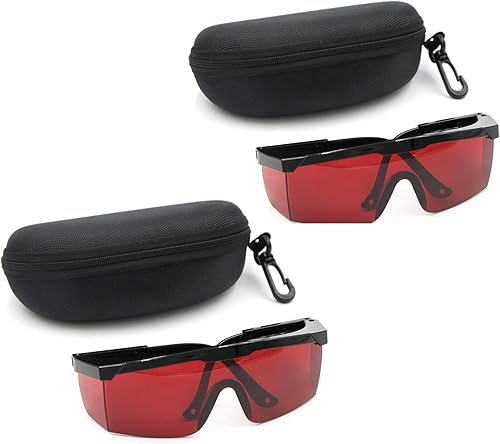
- 2 glasses and 2 cases
- 190–540nm protection
- Adjustable frame
- About 18g each
- Velvet boxes included
GOSONO provides two lightweight pairs for lower-wavelength laser tasks and shared use. Its 190–540nm range is far below the 10600nm output associated with CO2 lasers.
Pros
- Two pairs and two cases
- Lightweight design
- Adjustable temples fit over ordinary glasses
Cons
- No CO2 wavelength coverage
- Limited to 190–540nm
GOSONO provides 2 pairs with 190–540nm protection, two cases and velvet boxes.
The soft plastic structure weighs about 18g per pair, and the temples adjust through 4 modes from 9–11.4cm.
Two pairs make this a simple option for a shared lower-wavelength workstation. Each user can keep a pair with its own case between sessions.
The light weight may suit longer wear or users who find heavy frames distracting. It can also help when glasses must be worn over ordinary eyewear.
The adjustable frame can be worn over ordinary glasses, which helps when two users need a simple lower-wavelength option.
That over-glasses fit removes the need to switch between prescription glasses and laser eyewear during a task. It can make set-up faster when the range matches the machine.
Its stated range includes ultraviolet and visible blue-green wavelengths. Those bands do not include the far-infrared output of a CO2 laser.
It does not cover 10600nm. That makes it unsuitable for a CO2 laser unless the brand confirms a different protection range for the exact model.
Choose GOSONO for shared lower-wavelength tasks where its range matches the machine. Do not choose it for CO2 work based only on the word “laser” in the name.
CARLANY CO2 Laser Safety Glasses OD 5+: Best for wide CO2 wavelength coverage
- 9000–11000nm protection
- OD 5+
- More than 90% visible light transmission
- Fits over most prescription glasses
- Case, cleaning cloth and manual included
CARLANY is a direct CO2 option with a wider 9000–11000nm range that includes 10600nm. Its high VLT keeps the view bright, while the over-glasses frame helps prescription-wearers.
Pros
- Wide CO2 range
- Fits over most prescription glasses
- High visible light transmission
Cons
- Lower OD than the Cloudray CO2 pick
- Lowest score for this search intent
CARLANY is the other dedicated CO2 option in this roundup.
It covers 9000–11000nm, which includes 10600nm, and uses absorption filtering with OD 5+.
That wider stated range gives some flexibility around the standard CO2 wavelength. It still needs to match the exact machine specification.
Its main advantage over the Cloudray CO2 model is range. Its main trade-off is the lower stated OD, although its more than 90% VLT gives the brightest view among the CO2-specific picks.
A bright view can be a real benefit during alignment, inspection and material checks. It may also make long sessions feel less tiring.
The lightweight black nylon frame fits over most prescription glasses. The package includes one pair, a protective storage box, a cleaning cloth and an instruction manual.
That combination suits users who do not want to remove their normal glasses. It also gives you the basics for storage and lens care from the start.
Choose CARLANY if you wear prescription glasses or want wider CO2 coverage with a bright view.
Choose Cloudray if OD 6+ at the stated 10600nm wavelength is the more important match.
How to choose laser safety glasses for a CO2 laser
The right laser safety glasses for a CO2 laser must match the machine's wavelength first. For the common 10600nm target in this guide, Cloudray and CARLANY are the direct matches.
Check the wavelength before the frame
A comfortable frame cannot compensate for the wrong filter range. Look for 10600nm, 10.6um or a range such as 9000–11000nm when shopping for CO2 protection.
Products designed for 405nm, 450nm, 532nm or 1064nm work may look similar but target different light. This is why the xTool, JILERWEAR, GOSONO and fiber-focused Cloudray models rank below the dedicated CO2 picks for this search.
Compare optical density and visible light transmission
Optical density describes how strongly the eyewear attenuates the covered wavelength. Cloudray states OD 6+, while CARLANY states OD 5+.
VLT describes how much visible light passes through. CARLANY's greater than 90% VLT will look brighter than Cloudray's 50%, while LaserPair's 23% VLT and ULTREMA's 15% VLT will look darker.
Do not pick by VLT alone. A bright view is useful, but the protection range and optical density must fit the laser hazard.
Match the fit to your workspace
An adjustable strap can help keep over-ear goggles in place during machine operation. An over-glasses frame can help prescription-wearers avoid removing their normal eyewear.
Wrap-around coverage, side wings and full-rim frames can reduce gaps around the eyes. Still, check how the goggles sit on your face and whether they interfere with other required protective equipment.
Store and clean the lenses carefully
Keep the glasses in their protective box or case between uses.
That simple habit protects the lenses from knocks, dust and scratches on a busy bench. It also keeps the eyewear in a known place before the next session.
Clean them with the care method stated for the model, such as a soft cloth, and avoid harsh chemicals where the product instructions warn against them.
Harsh cleaning can damage coatings or lens surfaces even when the frame still looks fine. Follow the notes for your exact pair rather than a general workshop routine.
Inspect the lenses before each session. Look for scratches, cracks, loose parts or a poor fit around the eyes.
If a reflective surface is scratched or the lens is damaged, replace the eyewear instead of continuing to use it.
Do not assume that a small mark has no effect on protection. The stated protection depends on the lens in its intended condition.
Check the frame and strap as well, because a loose fit can leave gaps around the eyes. Replace worn parts or the whole pair when the fit no longer feels secure.
For users who wear prescription glasses, check whether the frame sits comfortably over them. A stable fit is easier to keep on throughout the job.
For a wider look at transparent eyewear options, see our guide to best clear laser safety glasses.
You can also compare the second guide titled Best Laser Safety Glasses For Engraving when your workspace includes more than one laser type.
Use those guides to understand different eyewear styles, then return to the wavelength check for your CO2 machine. Style and clarity only help once the protection range is correct.
Keep a second pair or a spare case where the machine is used most often. That makes it easier to protect every user and to retire a damaged pair without delay.
Which laser safety glasses are best for CO2 lasers?
Pick Cloudray CO2 Laser Safety Glasses when your machine uses 10600nm and you want OD 6+ with 50% VLT.
That is the most direct match in this guide for a standard CO2 engraver or cutter. The 50% VLT also gives a reasonably bright view for everyday machine work.
Pick CARLANY when you need 9000–11000nm coverage, a bright view or a frame that fits over prescription glasses.
Its more than 90% VLT makes it the brightest of the CO2-specific picks. The trade-off is OD 5+ rather than OD 6+.
Choose LaserPair only when broad visible and near-infrared coverage matters more than dedicated CO2 protection. Its stated ranges do not include 10600nm.
The other picks are better for compatible blue, IPL, fiber or shared-workspace applications, not as substitutes for 10600nm eyewear.
That distinction is the key takeaway for a CO2-only shop. Start with the machine wavelength, then compare optical density, visibility and fit.
If you run more than one laser type, keep the eyewear matched to each machine. Separate pairs with clear labels can prevent a wavelength mix-up.
Store the glasses in their box or case and inspect them before use. Replace a damaged pair rather than continuing with compromised eyewear.
Confirm the exact protection details for your model before the first session. The right choice is the one whose stated range includes your machine's wavelength.
Our top 3 picks at a glance
-
1
Best for broad wavelength coverage
LP-LaserPair LaserPair Laser Safety Glasses 200-534nm
9.7/10 our score
See it on Amazon -
2
-
3
Best for fiber laser work
Cloudray CE 1064nm Laser Safety Goggles Protective
9.6/10 our score
See it on Amazon
Frequently asked questions
What wavelength should CO2 laser safety glasses cover?
CO2 laser safety glasses should cover the wavelength produced by your machine. The common CO2 wavelength in this guide is 10600nm, or 10.6um.
Cloudray covers 10600nm with OD 6+, while CARLANY covers 9000–11000nm and also includes 10600nm.
Are regular safety glasses enough for a CO2 laser?
Regular workshop safety glasses are not automatically suitable for a CO2 laser. Choose eyewear with a stated protection range that includes your machine's wavelength and an optical density suited to the hazard.
A darker tint alone does not prove the correct protection.
Is OD 5 or OD 6 better for CO2 laser glasses?
OD 6 provides more attenuation than OD 5 at the covered wavelength, so it can be the stronger choice when the range and machine requirements match. Cloudray states OD 6+ for 10600nm, while CARLANY states OD 5+ across 9000–11000nm.
Can I use fiber laser glasses with a CO2 laser?
Usually not. Fiber laser glasses in this guide target 1064nm, 1070nm, 1080nm or 1100nm, while the CO2 options target 10600nm.
Match the glasses to the laser's actual wavelength instead of choosing by brand or appearance.
Do CO2 laser glasses replace an enclosure?
No. Eyewear is one part of laser safety and does not replace an enclosure, interlock, safe operating procedure or proper training.
Use protection that matches the machine and follow the safety guidance for your equipment and workspace.


