
The best laser safety glasses for engraving are the pair matched to your laser’s exact wavelength, and nothing else matters until that box is ticked. A CO2 pair does nothing against a blue diode beam, and a diode pair is useless against invisible fiber light.
So the answer depends on your machine. If your bench runs more than one laser type, the LaserPair dual-band goggles are our overall pick. Running a CO2 laser? Get the Cloudray OD 6+. On a diode engraver? The JILERWEAR OD 6+ is the match.
As an Amazon Associate, I earn from qualifying purchases.
This guide also answers what the other roundups skip: whether an enclosed machine needs glasses at all, and how to spot a faked optical-density claim before it costs you your sight.
Top Picks at a Glance

LaserPair Dual-Band Goggles
Diode and fiber protection in one certified pair, ideal for a multi-machine shop.
See it on Amazon
Cloudray CO2 OD 6+ Goggles
A dedicated 10600nm filter with a bright 50% view, so you can watch the cut.
See it on Amazon
JILERWEAR OD 6+ Goggles
OD 6+ across the blue and green diode bands with a sealed, comfortable fit.
See it on AmazonRead the table in that order: match your laser’s wavelength first, then compare optical density, then everything else. Glasses are only one item in the kit, so pair this with our full laser engraving safety equipment checklist.
| Photo | Material | Best for | Score | Buy |
|---|---|---|---|---|
|
LaserPair Dual-Band Goggles | Overall for Multi-Laser Shops | 6.8/10 | Check price |
|
Cloudray CO2 OD 6+ Goggles | CO2 Laser Engravers | 6.8/10 | Check price |
|
JILERWEAR OD 6+ Goggles | Diode Laser Engravers | 6.8/10 | Check price |
 |
TRQWH OD 7+ Fiber Goggles | Fiber Laser Marking | 6.8/10 | Check price |
 |
Dubofu OD 5+ Full-Seal Goggles | Budget Fiber and Diode Pair | 6.8/10 | Check price |
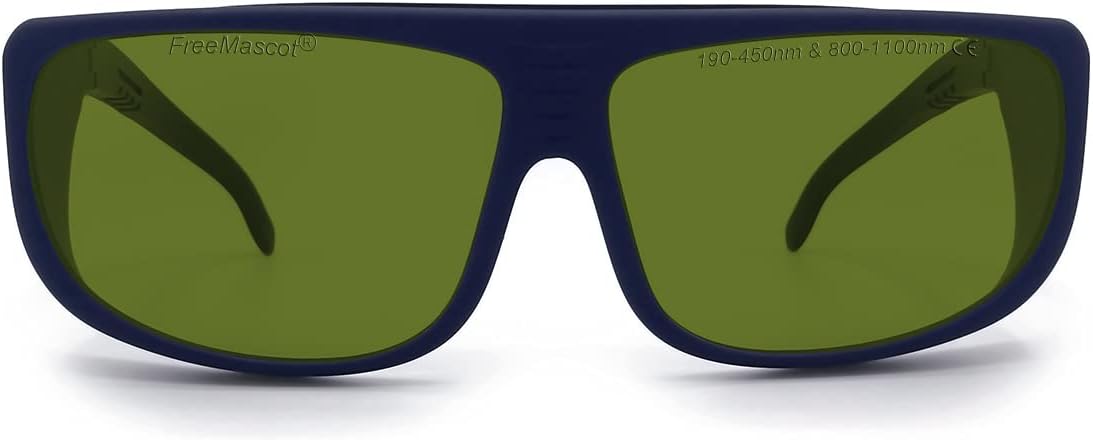 |
FreeMascot OD 8+ Laser Glasses | Highest Optical Density for Diode Work | 6.8/10 | Check price |
 |
BLUETIMES OD 6+ Laser Goggles | Broad-Spectrum Alternative | 6.7/10 | Check price |
 |
mozeeda OD 5+ Laser Glasses | Cheap Starter Pair | 6.5/10 | Check price |
Scroll sideways to see every column.
Every pick here also carries a score out of 10. It is ours, not Amazon’s, and it is not a test result, because we have not fired a laser through any of these lenses. The number weighs each pair’s stated optical density and certification, how well its filter band matches a real engraving wavelength, fit and comfort, and what owners report once the novelty wears off.
Do You Actually Need Laser Safety Glasses?
Here is the honest answer almost no buying guide will give you: it depends on your machine, and for some machines the answer is no.
A fully enclosed engraver can be safe to run with the lid shut and no glasses on. Glowforge is the clearest example. Its own safety documentation classes the Basic and Plus as Class 1 products that contain an embedded Class 4 laser.
The case and glass lid block the hazardous infrared and UV, and door interlocks cut power the instant the lid opens. In normal, lid-closed use the beam is fully contained, so the whole machine behaves as Class 1.
The Glowforge Pro is the exception in that same range: open its passthrough slot and you create a Class 4 exposure, so glasses go on.
This is a general principle of laser safety, not a Glowforge quirk. A properly interlocked, undamaged enclosure turns a high-power embedded laser into a Class 1 system that does not need routine eyewear during sealed operation.
That principle only holds while the enclosure stays intact. Here is the rule in plain terms:
- Optional for a compliant, undamaged, fully enclosed machine run with the lid or door closed.
- Mandatory for any open-frame diode engraver, because there is no enclosure at all.
- Mandatory for passthrough-slot work, or for running with the lid open.
- Mandatory while servicing, aligning, or testing with the cover off.
- Mandatory the moment an enclosure is cracked, missing a panel, or has its interlocks bypassed.
If you own an open-frame diode engraver, the most common hobby machine by far, you live in the mandatory column all the time. Glasses are not optional gear for you. For the bigger picture on running one at home, see whether laser engraving is safe indoors.
LaserPair Dual-Band Goggles: Best Overall for Multi-Laser Shops
If your bench holds more than one kind of laser, this is the pair that saves you from owning three. It filters a UV, blue and green band plus a separate near-IR fiber band, so one set covers a diode engraver and a fiber marker.
Protection is OD 7+ across the 180-534nm band and OD 5+ or better from 740-1095nm, and it is certified to EN207 and A1EN207 by DIN CERTCO, a named European test house. It is sold as compatible with the xTool F1, F1 Ultra, S1, M1, M1 Ultra, D1 and D1 Pro, so xTool owners can match by model.
The one grumble is the view. Light transmission is quoted at both 23% and 30%, so plan for a noticeably darker window either way.
- Two protection bands in one pair: UV, blue and green, plus near-IR fiber and YAG
- OD 7+ across 180-534nm and OD 5+ or better from 740-1095nm
- Certified to EN207 and A1EN207 by DIN CERTCO
- Rated for xTool F1, F1 Ultra, S1, M1, M1 Ultra, D1 and D1 Pro
- Wrap-around TR90 frame with side ventilation
- One of the pricier pairs in this lineup
- Light transmission is given as both 23% and 30%, so expect a dim view
- Skips the CO2 10600nm band, so it is not a CO2 pair
- Optical density
- OD7+ (180-534nm & 900-1095nm), OD5+ (740-900nm) per bullets
- Wavelength
- 200-534nm and 740-1095nm
- Light transmission
- 23-30% (listing inconsistent)
- Certification
- CE EN207 + A1EN207 (DIN CERTCO)
Best for: a shop running a diode engraver and a fiber marker that wants one pair instead of two.
Cloudray CO2 OD 6+ Goggles: Best for CO2 Laser Engravers
A CO2 laser fires at 10.6 microns, a wavelength so far into the infrared that diode and fiber filters do nothing against it. This pair is built for that line and only that line.
Protection is OD 6+ at 10600nm, certified to EN207, with a filter made from DuPont PA66. The view is a strong point too: 50% light transmission is the brightest of the single-band CO2 pairs here, so you can actually watch the cut. An adjustable head strap lets it sit over prescription glasses.
Just know its limits. It is CO2 only, so a diode or fiber machine needs its own eyewear, and it ships as a single pair.
- OD 6+ tuned to the 10.6 micron CO2 wavelength, certified to EN207
- 50% light transmission keeps the cut easy to watch through a CO2 filter
- Adjustable strap fits over prescription glasses
- Filter uses DuPont PA66 material
- CO2 only, so it does nothing against a diode or fiber beam
- One wavelength band, so a mixed shop needs a second pair
- Ships as a single pair, so a spare or a helper means buying another
- Optical density
- OD 6+
- Wavelength
- 5000-11000nm, typical 10600nm (10.6um)
- Light transmission
- 50%
- Certification
- CE EN207
Best for: CO2 engraver and cutter owners, from a K40 to an OMTech or Boss cabinet.
JILERWEAR OD 6+ Goggles: Best for Diode Laser Engravers
Open-frame diode engravers are the machines where glasses stop being optional, and this is the pair to reach for. It filters OD 6+ from 180nm to 540nm, which covers the common 405, 445, 450, 473 and 532nm diode wavelengths.
Fit is the strong point. A silicone gasket seals the gap around your face so stray light cannot sneak in from the side, and 55% light transmission keeps the workpiece easy to see. It is sold specifically for laser cutting and engraving, not repurposed from a beauty-salon listing.
The trade-off is range. There is no infrared coverage at all, so it is worthless the moment you bolt a 1064nm fiber module onto the frame.
- OD 6+ from 180-540nm, covering the 405, 445, 450, 473 and 532nm diode lines
- 55% light transmission keeps the work easy to see
- Silicone gasket seals out side-entry light
- Sold for laser cutting and engraving, not a repurposed beauty listing
- No infrared coverage, so useless with a 1064nm fiber module
- Diode-and-green range only, a single-purpose pair
- Little owner detail beyond the core spec sheet
- Optical density
- OD 6+
- Wavelength
- 180-540nm (protection wavelength spec)
- Light transmission
- 55%
- Frame
- Full rim, snug fit
Best for: diode engraver owners running an xTool D1, Sculpfun, Ortur or Atomstack.
TRQWH OD 7+ Fiber Goggles: Best for Fiber Laser Marking
Fiber lasers are the sneaky ones. The 1064nm beam is invisible, so there is no bright flash to make you flinch, which is exactly why eyewear matters more here, not less.
This pair filters OD 7+ across 800-1100nm, the band that brackets that 1064nm line, and it is backed by both US FDA and CE EN207 testing, with DIR LB5 and IR LB7 safety ratings called out. That is one of the more thoroughly documented certification stories in the group.
Two things hold it back. It is newer, with a thin owner history behind it, and at 29% light transmission it dims the work area more than the CO2 or budget picks.
- OD 7+ across 800-1100nm, covering the 1064nm fiber line
- Backed by US FDA and CE EN207 testing, with DIR LB5 and IR LB7 ratings
- Built specifically for fiber and Nd:YAG marking
- Light universal-fit frame with a polycarbonate lens
- Thin owner history compared with the Cloudray or JILERWEAR picks
- 29% light transmission dims the work area
- Fiber and near-IR only, no diode or CO2 protection
- Optical density
- OD 7+
- Wavelength
- 800-1100nm
- Light transmission
- 29%
- Certification
- US FDA + CE EN207 (DIR LB5, IR LB7 per bullets)
Best for: fiber marking machine owners running a JPT or Raycus-style source.
Dubofu OD 5+ Full-Seal Goggles: Best Budget Fiber and Diode Pair
Dubofu OD 5+ Full-Seal Goggles
If you want fiber and diode coverage in one pair but do not want to pay the LaserPair premium, this is the value play. It filters OD 5+ across 200-450nm and 800-2000nm, including the 1064nm fiber line.
It is genuinely built for the job, sold for fiber and diode engravers rather than adapted from a cosmetology listing, and it carries EN207 certification. A full-seal frame with an adjustable strap closes the side gaps.
What you give up is track record and margin. It has the thinnest owner history here, and OD 5+ is a step below the OD 7+ you get from the dedicated TRQWH fiber pick.
- Fiber and diode coverage in one pair: 200-450nm and 800-2000nm
- OD 5+ including the 1064nm fiber line
- EN207 certified
- Full-seal frame with an adjustable strap
- The thinnest owner history in this lineup
- OD 5+ trails the dedicated TRQWH fiber pair’s OD 7+
- Little detail beyond the core spec sheet
- Optical density
- OD 5+
- Wavelength
- 200-450nm and 800-2000nm, incl. 1064nm
- Light transmission
- 30%
- Certification
- EN207
Best for: budget-minded owners of a fiber or diode engraver who want a purpose-built pair.
mozeeda OD 5+ Laser Glasses: Best Cheap Starter Pair
This is the cheapest way onto this page, and by a wide margin. It is also the most reviewed genuinely engraving-relevant pair here, which counts for something at the price.
Coverage is broad on paper, 190-480nm and 750-2000nm, and its use list names laser marking, cutting and welding alongside hair removal.
Read the fine print, though. The same pair is described as both OD 3+ and OD 5+, and its light transmission is quoted at both roughly 10% and 29%. When a product cannot decide what it protects to, treat the headline number as a ceiling, not a promise. It is an honest starter pair, not a primary recommendation.
- The most affordable pair here by a wide margin
- The largest owner following of any engraving-relevant pick
- Broad stated coverage: 190-480nm and 750-2000nm
- CE certified across the EN207, EN166, EN167 and EN168 family
- Anti-fog coating and adjustable temples
- Its own numbers list both OD 3+ and OD 5+, so trust the lower figure
- Light transmission is quoted at both roughly 10% and 29%
- Marketed for IPL and hair removal first, engraving second
- Optical density
- OD 3+ to OD 5+ (listing states both figures)
- Wavelength
- 190-480nm and 750-2000nm
- Light transmission
- ~10-29% (listing gives both figures)
- Certification
- CE EN207 / EN166 / EN167 / EN168 (per bullets)
Best for: beginners who want a cheap, broad pair for a first diode or CO2 machine.
FreeMascot OD 8+ Laser Glasses: Highest Optical Density for Diode Work
FreeMascot OD 8+ Laser Glasses
If you want the most optical density on this page for a diode module, this is it: a headline OD 8+, the highest here. Its spec sheet names 405nm and 445nm directly, the two most common diode-engraver bands, and 60-65% light transmission keeps the view bright.
It reads as an industrial product too, listed for electronics, laboratory and manufacturing use rather than the beauty market.
Here is the catch, and it matters. The title advertises 800-1100nm infrared coverage, but the detailed specs only confirm the 190-450nm UV and blue band. The two also disagree on optical density, OD 8+ in one place and OD 5+ in another. Verify the infrared claim before you trust these anywhere near a fiber module.
- OD 8+, the highest stated optical density in this lineup
- Names 405nm and 445nm, the common diode-engraver bands
- 60-65% light transmission for a bright view
- Listed for electronics, lab and manufacturing use, not beauty
- The infrared 800-1100nm claim is not confirmed by the detailed specs, so verify before fiber use
- Its own figures disagree: OD 8+ in one place, OD 5+ in another
- Modest owner history next to the JILERWEAR or Cloudray picks
- Optical density
- OD 5+ to OD 8+ (spec table and title differ)
- Wavelength
- 190-450nm confirmed in spec table; title additionally claims 800-1100nm
- Light transmission
- 60-65%
- Certification
- CE EN207
Best for: diode-engraver owners who want extra optical-density margin around a 445nm module.
BLUETIMES OD 6+ Laser Goggles: Broad-Spectrum Alternative
This is the other one-pair-for-everything option, covering a UV and diode band from 200-450nm and a near-IR band from 800-2000nm, including 1064nm, all at OD 6+. On top of the optical rating it passed a stated 150J impact test, and it is very light at a stated 0.8oz.
It is sold for industrial laser engravers, cutters and welders, though the same listing pushes laser hair removal just as hard.
The reasons it lands last are simple. Owners rate it a little below the rest of the group, it has one of the thinnest review histories here, and its certification is listed only as generic CE without a named EN207 reference.
- OD 6+ across both a UV and diode band and a near-IR band including 1064nm
- One pair spans diode and fiber wavelengths
- Passed a stated 150J impact test on top of the optical rating
- Very light at a stated 0.8oz, with a 2.5mm coated polycarbonate lens
- Owners rate it slightly below the rest, on a thin review history
- Marketed just as hard for hair removal, so it is not engraving-first
- Certification is listed only as generic CE, without a named EN207 reference
- Optical density
- OD 6+
- Wavelength
- 200-450nm and 800-2000nm, incl. 1064nm
- Certification
- CE
- Frame
- Full rim, lightweight (0.8oz)
Best for: a shop that wants one broad-spectrum pair and will accept a lighter track record.
How to Choose Laser Safety Glasses for Engraving
Buying eyewear is a decision made in order. Get the first step right and the rest is fine-tuning; get it wrong and nothing else can save you.
Wavelength Coverage Comes First
Your glasses must protect the exact wavelength your laser emits. If your beam falls outside the filter’s rated band, you get zero protection, no matter how high the OD number looks.
This is the one rule the cheap “all-wavelength” listings blur. Match the band first, then compare anything else. The laser-type section below lists the ranges to look for.
Optical Density (OD)
OD measures how much the lens cuts the beam at the rated wavelength. Each whole number is another tenfold reduction: OD 5 blocks 100,000 times the light, OD 6 a million, OD 7 ten million.
Engraving eyewear in this field clusters between OD 5 and OD 8. Higher is safer, but only inside the stated band. An OD 8 diode filter still does nothing against CO2 light.
Visible Light Transmission (VLT)
VLT is how much ordinary light gets through, and it decides whether you will actually keep the glasses on. The Cloudray pair passes 50% and the FreeMascot 60-65%, so the workpiece stays clear; the TRQWH pair sits at 29% and dims the room.
Protection always wins the argument, but a pair so dark you push it up your forehead protects nothing. Pick the brightest option that still covers your wavelength.
Fit, Seals, and Wearing Them Over Prescription Glasses
Light comes in from the sides too, so a good seal matters as much as the lens. Wrap-around frames, silicone gaskets and full-seal straps all close that side path.
If you wear prescription glasses, look for a strap-style over-fit. The Cloudray CO2 pair’s adjustable strap and the Dubofu full-seal strap are both built to sit over everyday frames. Still choosing the machine itself? Start with our guide to choosing a laser engraver.
Which Glasses for Your Laser Type: Diode, CO2, and Fiber
There is no single pair that covers every laser, and any listing that claims otherwise is the one to distrust. Here is how the three common families break down, and which pick fits each.
Diode (Blue) Lasers, ~405-455nm
Diode engravers are the open-frame machines most hobbyists own, and the ones where glasses are always mandatory. The JILERWEAR or FreeMascot pairs are the matches; go LaserPair if a fiber module also lives in the shop. Not sure which family you have? Our explainer on the difference between diode and CO2 lasers sorts it out.
CO2 Lasers, 10,600nm
CO2 light sits far into the infrared and needs its own dedicated filter, and the Cloudray pair is the pick. Most CO2 machines are enclosed cabinets, so remember the earlier rule: run lid-closed on an intact enclosure and glasses become optional, but reach for the Cloudray the moment you open it up or service it.
Fiber and Infrared Lasers, ~1064nm
Fiber is the most dangerous to underestimate because the near-infrared beam is invisible. There is no visible flash to trigger a blink reflex, so the eyewear is doing all the work. The TRQWH pair is the dedicated pick, the Dubofu the budget one. Marking tumblers with a fiber machine? See our roundup of fiber lasers for tumblers.
How to Spot Fake OD Claims Before You Buy
This is a low-cost product where the stakes are your eyesight, exactly the combination that attracts copied numbers. “Buy a reputable brand” is not useful advice, so here is a checklist you can actually run.
- The OD rating and wavelength range should be etched or printed on the lens or frame itself, not just on the box.
- There should be a named manufacturer with a compliance or test document you can find, not a storefront name that exists only on the marketplace.
- Prefer a laser-type-specific pair over one bargain “covers everything from UV to 2000nm” set. Broad and cheap is the classic tell.
- Treat a CE sticker as a starting point, not proof. The mark is easy to copy at this end of the market, so it cannot stand on its own.
Why bother? An independent bench test by Alex Whittemore fired laser pointers at cheap Amazon glasses and measured real power leaking through despite the printed OD. His test used pointer wavelengths, not engraving bands, so read it as a warning about trusting a printed number, not a verdict on any one product.
The three pairs above whose own numbers disagree, the mozeeda, the FreeMascot and the LaserPair, are live proof of why this matters. When a listing cannot keep its own OD or VLT straight, that is your cue to verify before you buy.
Standards, Certifications, and When to Replace Your Glasses
The alphabet soup on these listings is simpler than it looks. Four codes cover almost everything you will see:
- ANSI Z136.1 is the US laser-safety standard that sets the framework for eyewear selection.
- CE EN207 is the European standard for laser protective eyewear, the one you actually want on engraving glasses.
- EN208 covers alignment eyewear, meant for setup at reduced power, not full-beam protection.
- EN166 is the general impact and eye-protection standard, about flying debris rather than laser light.
Now the question no competitor answers: when do these expire? The short version is that there is no universal printed expiration date.
You will see a “5-year maximum” figure quoted around the web. Treat it as a conservative ceiling for glasses baking in a hot, sunlit shop, not a hard rule.
Filter maker NoIR is blunter: a molded-in filter does not lose its optical density if the lens is undamaged and well cared for. The real trigger is condition, not the calendar.
Run this quick check before each session, and replace on any single failure regardless of age:
- Scratches deep enough to scatter light across the lens.
- Coating that is cracked, bubbled or peeling.
- A frame warped or cracked so the seal no longer sits flush.
- Lens discoloration, cloudiness or fogging that will not clean off.
FAQ
Do I need laser safety glasses with a Glowforge or other enclosed machine?
Not during normal, lid-closed use of an undamaged, interlocked Class 1 enclosure, which is how Glowforge classes its Basic and Plus. You do need them for passthrough work, running with the lid open, servicing, or any enclosure that is damaged or has its interlocks bypassed.
Can I use one pair of glasses for both my diode and CO2 laser?
No. CO2 light at 10,600nm and a diode beam near 450nm need completely different filters, and no pair in this lineup covers both. Plan on a separate pair for each wavelength band you work with.
Do laser safety glasses expire?
There is no printed expiration date. Replace them on condition, meaning scratches, cracked coating, warping or discoloration, and treat five years as a conservative cap for glasses stored in a hot, sunlit shop rather than a strict rule.
Do cheap Amazon laser glasses actually work?
Sometimes, but not always. An independent bench test found budget pairs leaking measurable power despite their printed OD, so run the fake-OD checklist above before you trust a bargain listing with your eyes.
Can I wear laser safety glasses over prescription glasses?
Yes, if you pick a strap-style over-fit design. The Cloudray CO2 pair’s adjustable strap is built to sit over prescription glasses, and the Dubofu full-seal strap works the same way.
What OD rating do I need for laser engraving?
It depends on your laser’s wavelength and power. The engraving-relevant pairs here cluster between OD 5 and OD 8, and remember that OD only counts inside the pair’s stated wavelength band. For fume safety, the sibling question to eye safety, see our guide on ventilation for a laser engraver.
