
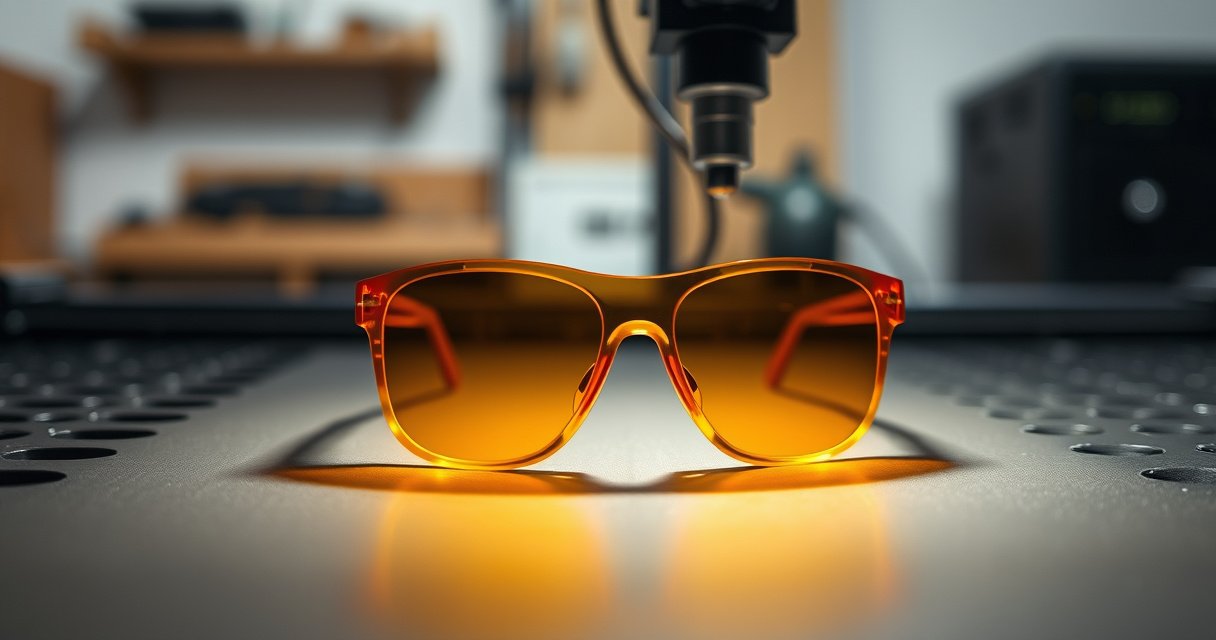
Do you need safety glasses for a laser engraver? Here’s the short version: it depends on your machine, and you can settle it in about ten seconds by reading one label. If your engraver is open-frame, meaning the beam runs in open air like most budget diode machines, then yes, you need wavelength-matched safety glasses every single time it runs.
If your machine is fully enclosed, interlocked, and certified Class 1, you don’t need glasses during normal closed-lid operation. You confirm which one you own by checking the classification label on the machine, not by trusting a blog.
One trap to flag right now: a dark lens that doesn’t match your laser’s wavelength protects nothing, no matter how black it looks.
Want to see that trap proven on camera first? This maker puts common safety-glass myths to the test, then read on for the checkable rule.
The Short Answer: Check Your Machine’s Laser Class Label
Under FDA regulation 21 CFR 1040.10, every laser product sold in the US must carry a classification label, usually near the power switch or the lens housing. That label lists a class from 1 through 4.

Class 1 means the protective housing prevents access to hazardous radiation during normal operation. So an enclosed, interlocked engraver with the lid closed needs no glasses to cut and engrave.
The catch is what “normal operation” means. The moment you open the lid, defeat an interlock, or do focus and alignment with the beam exposed, the machine is no longer behaving as Class 1. Glasses become mandatory again.
Open-frame diode machines are the simple “yes, always” case. There’s no housing between your eyes and the beam, so protection is on the whole time the laser can fire.
How to Read the Classification Label
- Find the label near the power switch or lens housing, and check the manual for the same class rating.
- Read the class number. Class 1 enclosed and interlocked is the “no glasses for closed-lid work” case; Class 3B or 4 is not.
- Confirm the interlocks are intact and unmodified. A taped-over or bypassed interlock voids the Class 1 protection completely.
- When in doubt, put the glasses on. If the label is missing, the machine is open-frame, or you can’t confirm the class, default to wearing rated eyewear.
Realizing your open-frame unit means goggles-on-forever? That’s often the moment people upgrade. Our guide to enclosed laser engravers for home use is a good next stop.
How a Laser Engraver Can Damage Your Eyes
The lens of your eye focuses light onto a tiny spot on the retina. At engraver power levels, even reflected or scattered light can burn the retina or cornea faster than your blink reflex can react.
It gets worse with invisible wavelengths: CO2 and fiber lasers emit in the infrared, so there’s no warning glow before the damage is done.
It isn’t only the direct beam either. Diffuse reflections off a shiny metal workpiece carry enough energy to hurt you.

That’s the whole point of the label rule: when the beam is exposed, your eyes have no natural defense, so the eyewear is the defense.
Safety Glasses Are Not Universal: Match the Wavelength, Not the Tint
This is the part most guides skip, and it’s the one that gets people hurt while they feel safe.

Optical density (OD) protection is only valid at the specific wavelength or wavelength range printed on the lens. A pair rated OD5+ for a 630-680nm red pointer can pass 450nm blue-diode or 10,600nm CO2 light almost untouched.
Here’s the trap: those wrong glasses look just as dark. Visible darkness tells you nothing about the invisible wavelength that’s dangerous.
The rule is simple: match the wavelength number on your machine’s own label or manual to the range printed on the glasses. Laser eyewear is marked with both its OD and the wavelengths it covers, so the number is there to read.
Not sure which laser you own? Start with our explainer on the difference between diode and CO2 lasers, then come back and match the number.
Diode Lasers (445-455nm)
This is the common open-frame hobby case, a blue visible-light wavelength. Glasses for it are typically sold at OD4-6+.
The green or orange acrylic shield bolted to the frame is a helpful supplement, not certified personal protection. Wear rated safety glasses anyway.
CO2 Lasers (10,600nm)
CO2 light is far-infrared and completely invisible, and eyewear for it is typically OD5-7+.
Most polycarbonate and acrylic blocks 10,600nm, which is why CO2 viewing windows work. But only glasses marked for 10,600nm count when the lid is open.
Fiber and Infrared Lasers (~1,064nm)
Fiber and Nd:YAG lasers sit in the near-infrared, invisible to you, with eyewear typically at OD6-7+.
These carry the highest stakes for a mismatch, because reflections off metal are strong and you’re often engraving metal directly. If you run a 1,064nm module, get this wavelength exactly right. Many of these live in our roundup of infrared laser modules for metal.
| Laser type | Typical wavelength | OD range commonly sold |
|---|---|---|
| Diode / blue | 445-455 nm | OD4-6+ |
| CO2 | 9,300-10,600 nm | OD5-7+ |
| Fiber / Nd:YAG | ~1,064 nm | OD6-7+ |
Scroll sideways to see every column.
Treat this as a shopping starting point, not a legal minimum. The exact OD a setup needs depends on the laser’s power and exposure time, so whatever your machine’s manual specifies wins over any chart.
How to Choose the Right Pair
Once you know your wavelength, pick glasses in this order of priority.
- Wavelength coverage first. The range printed on the glasses must include your machine’s wavelength. This is non-negotiable and comes before everything else.
- OD rating at that wavelength. OD is a log scale, so OD3 blocks about 1,000x the light, OD4 about 10,000x, and so on. Higher is stronger, and your manual’s number is the floor to meet.
- Real markings. Legitimate eyewear has the OD and wavelength printed on the frame or lens, per ANSI Z136.1 (EN207 is the European equivalent). Unmarked “laser glasses” from random listings are a red flag.
- Fit and side coverage. Reflections can enter at the temples, so wraparound frames or side shields matter as much as the lens itself.
Glasses are one item on a longer list. For the extinguisher, ventilation, and the rest, see our full laser engraving safety equipment guide.
If You Wear Prescription Glasses
You’ve got two real options, and each has an honest trade-off.
Fitover frames go on over your existing glasses and cost less. The catch: they must seal at the temples with no gaps, and they fog up, tempting you to lift them at exactly the wrong moment.
Dedicated Rx inserts or prescription-ground safety lenses cost more, but you actually keep them on. The trade is plain: cost versus compliance.
When to Wear Them: Best Practices
Turn the class-label rule into habits you don’t have to think about.
- Open-frame machine? Glasses go on before the laser can fire and stay on until it’s off. No exceptions.
- Enclosed machine? Put the glasses on any time the lid is open with the laser armed, including framing, focusing, alignment, and mid-job checks.
- Never defeat, tape over, or bypass an interlock. That single shortcut turns a Class 1 machine into an open hazard.
- Everyone in the room with a running open-frame laser needs protection, not just the operator. Pets can’t wear goggles, so they leave the room.
Eyes are one half of the room-safety question. The other half is air, covered in is laser engraving safe indoors and ventilation for a laser engraver.
FAQ
Can I use sunglasses or welding glasses instead of laser safety glasses?
No. Tint darkness has nothing to do with wavelength attenuation. Only eyewear marked with an OD for your laser’s specific wavelength protects you.
Do I need safety glasses with a fully enclosed laser engraver?
Not during normal closed-lid operation if the machine is certified Class 1 with intact interlocks. But yes, the moment the lid opens or you align or focus with the beam exposed.
Does the tinted acrylic shield on my diode engraver count as eye protection?
Treat it as a supplement, not certified personal protection. It carries no OD rating for your eyes and doesn’t cover reflections escaping an open frame, so wear rated glasses anyway.
What OD rating do I need for a diode laser engraver?
Glasses covering 445-455nm are commonly sold at OD4-6+. The exact minimum depends on your laser’s power, so follow the OD your machine’s manual specifies.
Do other people in the room need laser glasses too?
With an open-frame machine running, yes. Everyone in the room needs wavelength-matched protection, and pets should simply be kept out.
