
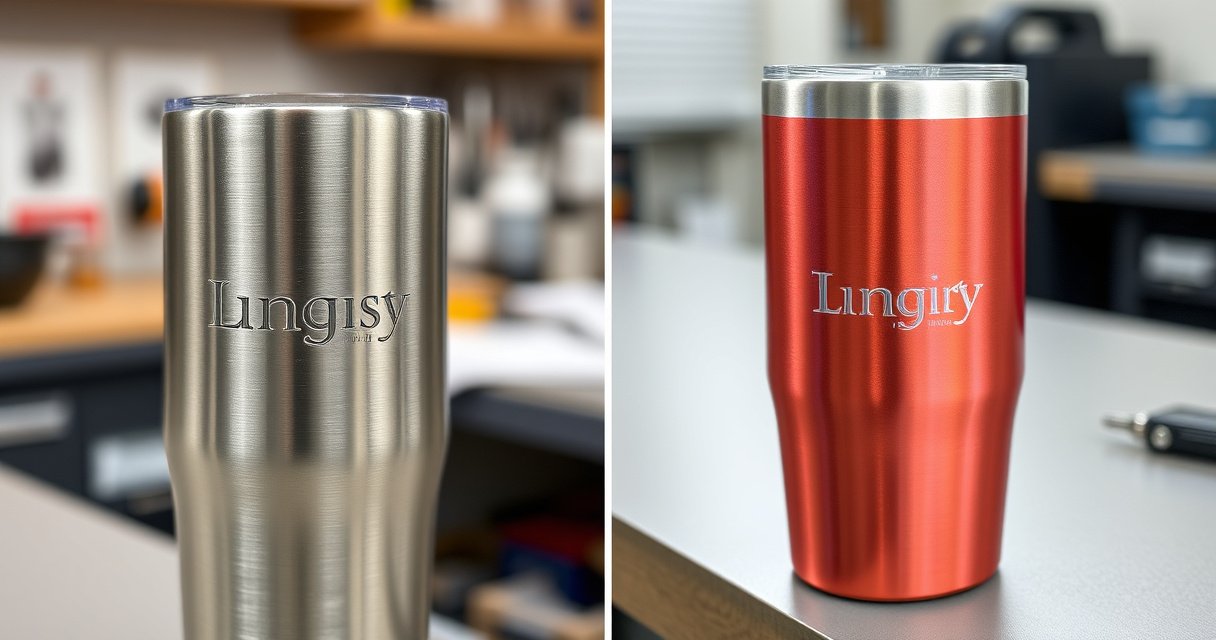
Here is the short answer to what is the difference between laser engraving and etching: engraving vaporizes material and cuts a groove you can actually feel with a fingernail, up to about 0.02 in deep on metal, while etching only melts the top surface layer, roughly 0.001 in or less, leaving a mark you mostly see rather than feel.
Engraving digs in. Etching stays on the skin.
Most pages that explain this are written for factories buying fiber-laser marking systems. This one is for you, standing at a desktop diode or CO2 machine, deciding what to do to the tumbler, sign, or keychain in front of you.
The simple rule: engrave anything that gets handled every day, and etch anything decorative or made in volume. Real settings and a material-by-material call come further down, so you can act on this today.
Prefer to see it before you read it? This short clip lines up marking, etching, and engraving side by side so the depth difference clicks.
What Is Laser Engraving?
Engraving is physical material removal. The beam heats one spot hot enough to vaporize it, so the surface is carried away and a recessed groove is left behind.

You can feel that groove. Run a finger over an engraved piece and you’ll catch the edges of the cut, which is the fastest way to tell an engrave from an etch.
Depth is what sets it apart. On metal the cut reaches up to about 0.02 in, and on softer materials it can go much deeper, closer to 0.125 in.
On a desktop machine, this is your high-power, slow-speed pass. It’s what a diode or CO2 laser does when you push power up and slow the head down on wood, leather, or coated metal.
Picture a bar sign cut into a slab of walnut, or a shop logo sunk into a leather patch. The mark is part of the material now, not a coating sitting on top of it.
Because engraving relies on removing material, deeper marks usually mean more passes. That’s a normal part of the process, and it’s the main reason engraving takes longer than a quick surface mark.
What Is Laser Etching?
Etching is surface melting, not removal. The beam melts a micro-thin layer, somewhere between about 0.0001 in and 0.001 in, and that layer expands and changes its texture or color.
Nothing gets dug out. You’re rearranging the very top of the surface, not carving into it.
On the same desktop machine, etching is the lower-power, higher-speed pass. Less energy, faster travel, and you skim the surface instead of cutting through it.
That’s why it’s gentler on thin or coated stock. A thin anodized layer or a slim sheet survives an etch that a deep engrave would blow right through.
An etched mark also feels smooth. There’s no groove to catch, just a change in color or sheen you read with your eyes.
It’s also why etching rules batch work. When you need fifty gift tags marked quickly, speed and a light touch matter more than depth, and etching gives you both.
The Difference Between Laser Engraving and Etching: Removing Material vs. Melting It
Both processes use the same tool, a focused laser beam. The difference is how much of the material you disturb.
Here’s the head-to-head:
- Depth: etching stays at roughly 0.0001-0.001 in; engraving cuts up to about 0.02 in on metal and deeper on soft materials.
- Energy: etching needs less power because nothing is vaporized; engraving needs more heat to carry material away.
- Speed: etching runs faster and often in a single pass; engraving runs slower and sometimes takes several passes to reach depth.
- Feel: an etched mark is smooth to the touch; an engraved mark has a groove you can feel.
Here’s the part the industrial pages skip. On a hobby machine, “etch” and “engrave” aren’t two different machines. They’re two different setting choices on the one laser you already own.
Same laser. You change power, speed, and the number of passes, and the same beam either skims the surface or cuts into it.
So the real question is never “which machine buys me etching.” It’s “what power and speed do I dial in for this job on the machine I’ve got.” If you’re still sorting out which machine type that is, the difference between diode and CO2 lasers is worth a quick read alongside this one.
Where Laser Marking Fits In
There’s a third word you’ll bump into: marking. Marking discolors the surface with no depth at all, so it’s even shallower than etching. Think of it as a color change on the skin, while etching is a texture change and engraving is a cut. Keeping the three straight saves you from mixing up terms that sound alike but do very different things to your material.
Real Diode Settings: Etch vs. Engrave on Anodized Aluminum
This is the box none of the ranking pages give you. These are published baselines for anodized aluminum, a favorite for tumblers and tags, credited to the people who measured them.
Deeper engrave (cutting through the coating):
- CNCSourced lists a diode baseline of a 10W laser at about 100% power and roughly 100-110 mm/sec.
- For CO2 under 60W, they suggest full power, or at least around 90%.
Shallow etch or color-layer mark (keeping the coating):
- Bonny Creations lists a 20W diode at 1500 mm/min and 70-80% power for fine detail.
- For standard marking, they list a 20W diode at 2000 mm/min and 60-75% power.
- On black anodized surfaces, they list a 10W diode at 900 mm/min and 75% power.
- Keep air assist off or minimal so you don’t blow oxide debris up into the lens.
Treat these as starting points and test on scrap first. Every material batch behaves a little differently, and your focus and lens condition matter too.
Notice the pattern more than the exact digits: the engrave setting leans on full power to cut through, while the etch settings pull power back to change only the color layer. For the full walkthrough, see our guide to laser engraving anodized aluminum step by step.
Durability: Which Mark Lasts Longer?
Engraving wins on longevity, and it isn’t close.
An etched mark is commonly rated to last roughly 5-10 years. That’s plenty for a lot of projects, but it is a surface layer, and surfaces wear over time.
An engraved mark is cut into the base material, so it’s effectively permanent. There’s no coating to rub off because the mark is the material itself.
Anodized aluminum makes the trade-off easy to picture. Engraving strips the anodized coating right down to bare aluminum, which then re-oxidizes fine under normal use.
Etching does the opposite. It leaves the anodized layer intact, so you keep the coating’s abrasion and corrosion resistance along with your mark.
Neither choice is wrong. It’s just a swap: engraving trades the coating for a mark that never leaves, while etching trades depth for a mark that keeps the surface protected.
The Dishwasher Test: When Depth Actually Matters
Here’s the rule the whole category is missing. If it gets handled daily or washed hard, engrave it. Tumblers, cookware, and tools all earn a deep cut, because a mark set into base material can’t wear off no matter how many wash cycles it sees. If it’s decorative, low-contact, or made in volume, etch it. Gift tags, batch logos, and one-off signage are all faster to etch, and where a coating exists you get to keep it. Planning drinkware? Our guide on how to laser engrave a tumbler is the direct next step.
Cost and Speed: Etching Is the Cheaper, Faster Pass
Etching is cheaper and faster for one plain reason: it disturbs less material.
Less material moved means less energy, higher travel speed, and usually a single pass. Engraving is the opposite on every count, slower speeds, higher power, and often multiple passes to reach depth.
For a hobbyist, the cost that matters is machine time. A batch of fifty etched keychains ties up your laser far less than one deeply engraved sign, and machine time is where a seller’s real cost lives.
That’s the whole reason production shops etch whenever a job allows it. If a shallow mark does the job, engraving just spends time and power you don’t need to spend.
One honest safety note. Engraving removes more material per pass, so it throws off more dust and fume volume than etching, especially on coated metals.
That deserves the same ventilation attention you’d give any deep cut. If you’re setting up a work area, our guide to ventilation for a laser engraver covers it in full.
Etch or Engrave? A Material-by-Material Call
Enough theory. Here’s the verdict for the projects people actually search this question for.
Wood, Leather, and Acrylic
These organics vaporize readily at diode and CO2 wavelengths, so “engraving” is the default. A high-power, slow pass gives you real depth for signs and cuts.

Drop the power and speed up, though, and a light pass leaves an etch-like surface mark that’s perfect for shading and large fills. That single-machine flexibility is why crafters lean on wood and acrylic so heavily.
Verdict: engrave for signs and depth, light-pass etch for photo shading and big filled areas.
Tumblers and Anodized Aluminum
This is where a desktop diode genuinely gets to choose. Etch the color layer for a crisp, high-contrast logo that keeps the protective coating.

Or engrave through it for a permanent mark on drinkware that gets used every day. Both look sharp, so the real decider is whether the piece faces daily washing or just sits on a shelf.
Verdict: etch for decorative contrast, engrave for daily-use durability. The numbers to dial in are in the settings box above.
Stainless Steel, Glass, and Slate
Time for honest limits. Bare metal like stainless steel needs a marking spray or a fiber/infrared source for a desktop user, since neither a diode etch nor a diode engrave marks it directly.
Glass and slate respond as surface fracturing, so a light etch-style pass is the goal, not a deep gouge. Push too hard on glass and you get chipping instead of a clean frosted mark.
Verdict: use marking spray or a fiber laser for bare steel, and keep it shallow on glass and slate. Our guide on how to laser mark stainless steel without a fiber laser shows the spray workaround.
Advantages, Disadvantages, and Which One to Choose
Here are the two processes side by side, in plain terms.
Laser engraving
- Pros: permanent, cut into base material, tactile groove you can feel, deep and high-contrast, survives daily use and washing.
- Cons: slower, needs more power and often multiple passes, and it destroys any protective coating in the mark area.
Laser etching
- Pros: fast, cheap per piece, gentle on thin and coated stock, and it keeps a protective coating intact where one exists.
- Cons: shallower, a mark life of roughly 5-10 years, and lower contrast on some materials.
So which one? Daily-use item, engrave it. Decorative or high-volume item, etch it. That one rule covers most of the decisions you’ll ever make.
If you now know which process you need but suspect your current machine can’t quite do it, start with our roundup of the best laser engravers for home use.
